Meiosis and Gamete Formation
Sexual vs. Asexual Reproduction
Organisms can reproduce with or without sex. Bacteria, and other single-celled organisms can simply undergo cell division to reproduce. Plants can create offshoots that will eventually separate from the parent and become an independent plant. Perhaps as a child you cut a worm in half and watched in some sort of awestruck horror as the two halves began to move as if each was its own worm. These are all forms of asexual reproduction. Only one parent and one set of genetic information is involved, and each offspring is a clone of the parent. Asexual reproduction is beneficial to propagate the species in times of environmental stress, or when mates are either few or out of reach.
Sexual reproduction, on the other hand, involves the mixing of genetic information from two parents; not blending, as some traits from one parent will dominate over those of the other parent, but combining. Sexual reproduction is evolutionarily favorable as it creates opportunities for genetic variation and new combinations of genes, but comes at a greater cost. For one, the mixing of genetic information from two parents has unpredictable results. Evolution proceeds randomly. Organisms who have genes that make them well-suited for survival will reach sexual maturity and pass those genes on to their offspring. Conversely, organisms who do not have genes that make them well-suited for survival will most likely die before reaching sexual maturity, removing their genes from the pool. When the goal of a species is to survive, and the goal of the individual to reproduce, that sort of genetic unpredictability may seem too risky. It seems, however, that the risk is minimal compared to the reward. After all, in a world that constantly changes, sexual reproduction can help a species keep up.
How Does Meiosis Allow DNA to Be Dividied Into Gametes?
Gametes are cells that are specialized to carry out sexual reproduction. A key difference between gametes and other cells is that they are haploid, or contain one set of chromosomes. They arise from diploid cells (containing 2 sets of chromosomes) through the process of meiosis. Not just any diploid cell produces gametes through meiosis; diploid cells destined to become haploid gametes reside in ovaries in females and testis in males.
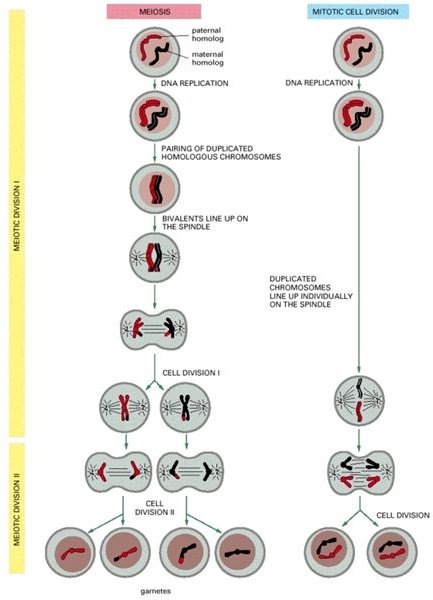
After DNA replication, homologous chromosomes (now 2 paternal and 2 maternal) pair together. Their proximity, and the large amount of shared DNA sequence, can lead to homologous recombination, also called crossing-over. This event accounts for genetic variability. The cell then undergoes not one, but two meiotic divisions, the process of which is similar to that of mitosis (chromosomes are attached to mitotic spindle and pulled to opposite poles, etc). The end result is four gametes, each containing one complete set of single chromosomes. Each gamete will contain an assortment of paternal and maternal chromosomes.
How does meiosis allow DNA to be divided into gametes? By undergoing two successive cellular divisions with only one round of DNA replication beforehand.
Images
Reference
Alberts B, Bray D, Johnson A, Lewis J, Raff M, Roberts K, Walter P. 1998. Essential Cell Biology: An Introduction to the Molecular Biology of the Cell. Garland Publishing, Inc: New York.
