What is the Difference Between Mitosis and Meiosis?
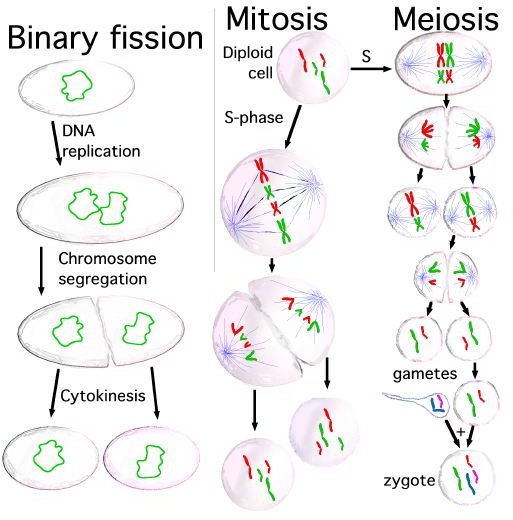
Mitosis and meiosis are two types of cell division that result in a replication of genetic material. But what is the difference between mitosis and meiosis? Each of these division processes is used for different types of cells. Meiosis, for example, is used for gametes, like sperm and eggs; mitosis, on the other hand, is used for other types of cells and results in an exact duplicate of the cell.
Differences between mitosis and meiosis are also found in the number of daughter cells produced, the number of chromosomes in each cell, and the process of the cell division.
Phases of Mitosis
There are seven phases of mitosis: interphase, prophase, metaphase, anaphase, telophase, G1 interphase and G2 interphase. During interphase, the nuclear membrane is intact, and the chromosomes are uncoiled. When mitosis proceeds to prophase, the spindle fibers form as the nuclear membrane disintegrates, which sets the cell up for division; the chromosomes are now coiled.
With metaphase, the chromosomes are aligned, resulting in a separation of chromatids in the anaphase. In each chromosome, there are two chromatids; when they separate, it allows for an equal number in each new cell. The eight chromosomes that were in the parent cell are now 16 chromatids.
In telophase, the parent cell divides into two daughter cells. In each daughter cell, there are eight chromatids. Since division is over, the spinal apparatus is dissembled and the nuclear membrane reforms. During the G1 and G2 interphase, the daughter cells adjust, allowing them to develop fully.
This is seen in the number of chromatids: during the G1 interphase, each chromosome has one chromatid; during the G2 interphase, each chromosome now has two chromatids. After the G2 interphase, the cell can be divided again.
Meiosis Phases
Meiosis has four phases per division — prophase, metaphase, anaphase and telophase — and two divisions. During prophase one, homologous chromosomes pair and cross over, which results in a mixture of genetic material.
The homologous pairs align at the center during metaphase one and separate during anaphase one. The parent cell then divides into two daughter cells during telophase one. The process repeats with prophase two, metaphase two, anaphase two and telophase two, resulting in four daughter cells.
What Is the Difference Between Mitosis and Meiosis?
The biggest difference between mitosis and meiosis is the genetic material. The two daughter cells produced during mitosis are genetically identical to the parent cell. The four daughter cells produced during meiosis, however, contain only half the number of chromosomes.
This is because these daughter cells are gametes, and are used for reproduction: they contain half the number of chromosomes since they will be merging with another gamete during fertilization. In addition, the crossing over during prophase results in genetic diversity that cannot occur with mitosis.
References
Clinton Community College: Mitosis and Meiosis, https://faculty.clintoncc.suny.edu/faculty/michael.gregory/files/Bio%20101/Bio%20101%20Laboratory/Mitosis/mitosis.htm
Genetics Home Reference: Mitosis and Meiosis, https://ghr.nlm.nih.gov/handbook/illustrations/mitosismeiosis
Image Credit: Three Cell Growth Types by Saperaud under CC by -SA 3.0
