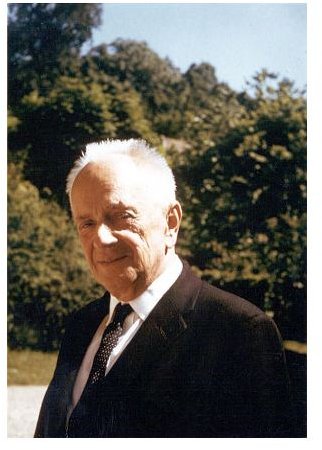
Theodosius Dobzhansky is known for his work on the population genetics of fruit flies. He studied the evolution of different fruit fly species and demonstrated the role that genetics played in evolution. His work gave rise to the modern evolutionary synthesis.
Theodosius Dobzhansky
A noted geneticist and evolutionary biologist, Theodosius Dobzhansky is renowned for his work in bridging Darwinian evolution with Mendelian genetics and paving the way for the science of the modern evolutionary synthesis.
In 1937, Dobzhansky published a book on evolutionary theory called “Genetics and the Origin of Species”. In this book, he laid the foundation for modern synthetic theory of evolution, by explaining the role of genetics in evolution by natural selection . Around the time this book was published, some researchers had begun to consider Darwin’s evolutionary theory rather dated. It didn’t, after all, appear to have an answer for the new genetic discoveries that were being made.
Dobzhansky studied population genetics in fruit flies and showed that the diverse genes in successfully evolved species helped them to adapt to different environments and conferred them with the genetic diversity that helped them to survive. Through his work he was able to show a single genetic mutation or change proceeded to affect the rest of the genetic arrangement and how this then led to an evolutionary change in the species. He explained that natural mutations occurred in species all the time, some harmful, some giving rise to gradual genetic changes. When individuals in a population with these mutational changes mated solely with one another, they gave rise to a new species with a genetically distinct identity.
Dobzhansky was one of the first Drosophila researchers to conduct field research on fruit flies. He travelled to Brazilian rain forests as well as around Mexico, Arizona and California in his search for different fruit fly species. He discovered that there were genetic similarities between different fly species from the same region. The same fly species from a different region were different genetically.
Early Life and Education
He was born on 24 January 1900 in Nemyriv, Ukraine, the only child of Grigory Dobzhansky a mathematics teacher and his wife Sophia Voinarsky. The family moved to Kiev in 1910 and faced some very difficult times during the period of the First World War and the Russian Revolution.
At high school in Kiev, Dobzhansky became interested in biology, started collecting butterflies and decided to become a biologist. Around 1915-1916 he met a young entomologist Victor Luchnik and was convinced to switch interest from butterflies to beetles. At the age of eighteen, Dobzhansky wrote his first scientific paper on lady beetles.
Career and the Death of Theodosius Dobzhansky
Even before he graduated from the University of Kiev in biology in 1921, Dobzhansky had been hired by the Polytechnic Institute in Kiev to teach zoology. He worked here until 1924 and then went to the University of Leningrad to work at the newly set up Genetics Department under Yuri Filipchenko. Filipchenko had started a Drosophila lab and Dobzhansky worked there until 1927 when he received a Rockefeller Foundation to go to the USA to work with the pioneer of Drosophila research Thomas Hunt Morgan at Columbia University.
He followed Morgan to the California Institute of Technology, where he worked as an Assistant Professor in Genetics. In 1936, he was made full Professor of Genetics and took US citizenship the following year.
In 1940, he returned to Columbia University as a Zoology Professor and remained there in that capacity until moving to teach at the Rockefeller University in 1962. He retired in 1970, becoming an emeritus professor, and the following year, became an adjunct professor at the University of California’s Genetics Department. He was working there at the time of his death on 18 December 1975.
Notable Publications
Genetics and the Origin of Species
Nothing in Biology Makes Sense Except in the Light of Evolution
Mankind Evolving
The Biological Basis of Human Freedom
The Biology of Ultimate Concern
Resources
https://books.nap.edu/html/biomems/tdobzhansky.pdf
https://evolution.berkeley.edu/evolibrary/article/ _0_0/history_20
https://www.stephenjaygould.org/people/theodosius _dobzhansky.html
https://www.stephenjaygould.org/library/dobzhansky _genetics.html