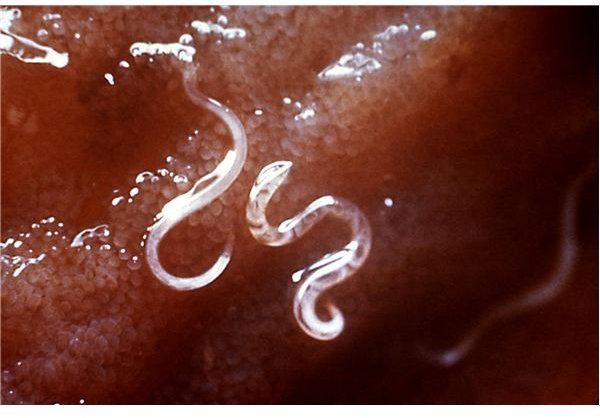
Hookworms are parasitic nematode worms that reside in the small intestine of their hosts which includes dogs, cats and humans. There are plenty of medications to eradicate hookworms and their eggs, but gene studies may help with the development of new and powerful treatment strategies.
Hookworms in Humans
Before looking at how gene studies can help to tackle hookworms in humans, here’s a brief overview of the troublesome parasites that are estimated to infect one quarter of the world’s population.
Two species of hookworms generally infect humans, Ancylostoma duodenale and Necator americanus and their route into the human body is through the skin when a person steps on fecal matter that is contaminated with hookworm larvae. Once inside they travel through the vascular system to the lungs, and then it’s onto the trachea where they are swallowed. As they pass down the esophagus and into the digestive system they attach to the walls of the small intestine and mature into adult worms. Here they mate and suck on the blood of their host.
Infection is usually asymptomatic for most of the time, but there may be symptoms such as skin irritation where the hookworms penetrated, asthma-like symptoms when they reach the lungs and gastro problems when the parasites are inside the digestive system. Here they can cause abdominal pain, diarrhea, and weight loss. A person may also appear anaemic as the hookworms feed off the host’s blood.
What Do Hookworms Look Like?
Hookworms are approximately 7-13mm in length. The head is bent at the anterior end to give the animal its characteristic hook shape for which it is named. Ancylostoma duodenale has a mouth with two sets of teeth and Necator americanus possess a pair of cutting plates, and the hook shape is more defined.
Tackling Hookworms in Humans
Hookworms are tackled with medications that are designed to kill the worms and their eggs. Cryotherapy is sometimes used when the hookworms are still in the skin. Although these treatments are generally successful, they are expensive and have to be used repeatedly as re-infection is common. Such widespread use diminishes their efficacy and this has provided a catalyst for scientists to carry out gene studies to be able to develop a vaccine or more powerful therapies that could reduce the severity of infections.
-
Many hookworm genes have been identified. For example in the year 2000, University of Edinburgh scientists discovered 161 new hookworm genes and worked out their functions, which included genes that coded for proteins involved in parasite-host interactions.
Advertisement -
In 2005 Washington University researchers presented a paper on their investigations into two species, Ancylostoma caninum and A. ceylanicum. They are minor parasites of humans, but are lab models for hookworm infection and disease, and they are closely related to the species that infect humans. More than 7,000 genes were studied and many were compared to the closely related C.elegans roundworm to try and ascertain their functions. The research has brought about a vast increase in hookworm sequence data that can help scientists to understand more about the basic biology of this parasite, and speed up the development of treatment strategies.
-
At the time of writing (September 2009) a small number of vaccine trials are underway or have taken place. In a study published in 2008 36 healthy volunteers were given a vaccine for N. americanus. The results were encouraging; there was a significant cellular immune response and it was shown to be safe. Further research is ongoing.
Advertisement
Sources
Investigating hookworm genomes by comparative analysis of two Ancylostoma species. Makedonka Mitreva et al
BMC Genomics 2005, 6:58doi:10.1186/1471-2164-6-58
Randomized, placebo-controlled, double-blind trial of the Na-ASP-2 Hookworm Vaccine in unexposed adults. ScienceDirect; Vaccine (2008) 26, 2408—2417. Peter J. Hoteza et al.