Endoplasmic Reticulum - functions and roles in the cell
Introduction
The endoplasmic reticulum or ER is a sub-cellular structure which performs several specialized tasks within the cell; hence it can be classified as an organelle. It is formed out of several interconnecting tubules and vesicles. The ER does not function in isolation, but coordinates with several other organelles. Endoplasmic reticulum functions include involvement in drug metabolism, production of steroids, storage of glycogen, facilitating the transport of proteins and protein folding.
In case you are interested in history, the ER was first officially seen by a team of biologists consisting of Keith R Porter, Albert Claude, and Ernest F Fullam and published in the year 1945 in a paper in The Journal of Experimental Medicine.
Type of Endoplasmic Reticulum
There are different types of ER found in complex cells namely smooth endoplasmic reticulum and rough endoplasmic reticulum. They differ not only in their physical appearance but in the way they function as well.
The smooth ER usually resembles a set of smooth tubes and it mainly acts as a storage point for steroids as well as ions. Both these substances have important functions in the cell activity. Sometimes there may be an immediate need for ions and they are supplied by the smooth ER in such a situation. There is also a special type of smooth ER which is known as the sarcoplasmic reticulum and though it is much similar to the normal smooth ER, its main difference lies in the fact that it is used to store calcium ions which are released upon muscle simulation.
The rough ER looks more like bumpy sheets rather than smooth tubes. They have ribosomes studded to them, and their main function is the manufacturing and packing of proteins. It must however be noted that the ribosomes are not permanently attached to these rough ERs, they adhere when protein manufacturing has to be carried out. After this process is complete the protein is then transferred on to the Golgi apparatus or the membrane of the cell via vesicles.
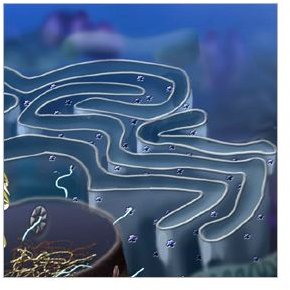
Where is the endoplasmic reticulum located? There is not one fixed point where the ER can be said to be concentrated since it forms a network of membranes and these are found throughout the cell. Also it is not necessary that the ER of various cells would look the same - they could be different based on their exact role in the cell. The sketch below shows the endoplasmic reticulum and the small dots represent the ribosomes that are studded to it.
