The human papilloma virus is a commonly occurring virus that infects humans. It can exist and replicate only in the epithelial surface of the skin. Some HPV types are cancer causing viruses.
What is Human Papilloma Virus?
A human papilloma virus (HPV) is a non-enveloped, double-stranded circular DNA viral molecule that infects and replicates in epithelial surfaces (keratinocytes). All skin and mucous membrane areas are particularly vulnerable to this virus. Over two hundred HPV types exist and different types cause different infections in different body areas. It is possible to be infected by different HPV types at the same time.
HPV-6 and HPV-11 cause visible, cauliflower-like warts that are generally painless. HPV-16, HPV-18, HPV-31, and HPV-45 are cancer causing viruses. They manifest themselves in flat, invisible growths. Other HPV types show no symptoms and are non-life-threatening.
HPV is commonly transmitted through sexual contact, but this isn’t always immediately apparent. The virus can lie dormant for several years and then suddenly activate and cause disease.
HPV Life Cycle
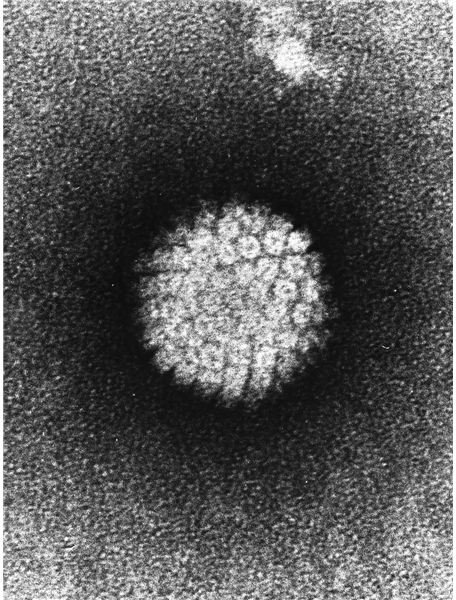
HPV is composed of eight genes - E1, E2, E4, E5, E6, E7, L1 and L2 - that are expressed at different times during the HPV life cycle and so are categorized accordingly as early or late.
At the start, the HPV virion infects epithelial tissues through micro-abrasions and enters the basal epithelial cells.
The viral genome then enters the cell nucleus and now the early E1 and E2 genes replicate the virus genome. E1 and E2 then build messenger RNA molecules . Each newly-built RNA molecule holds a copy of the DNA genetic information. This copying process is known as transcription. Soon each cell has a few to several hundred copies of the virus genome.
As the host epithelial cells divide and differentiate, a transcription cascade takes place.
E4 and E5 genes, respectively, assist in the virus genome production and controlling the rate of the epidermal growth factor.
E6 and E7 interfere with the work of the human genes Rb and p53 that regulate normal cell division.
The function of Rb is to accumulate important proteins like the E2F protein that are essential for cell division; if enough proteins are not accumulated, Rb prevents cell division from taking place.
p53 is responsible for repairing DNA damage in cells. It halts cell division until the damage is fixed. If the damage cannot be fixed, p53 makes sure the damaged cell dies without reproducing.
In HPV infection, E6 binds with p53 and E7 binds Rb. E6 stops p53 from repairing cell damage or causing the damaged cell to die, and it prevents cell division until either of the two takes place. E7 stops Rb from accumulating necessary proteins and from preventing cell division if the proteins are not accumulated.
This leads to the continued cell division of damaged cells, and can end up causing cancer or tumors .
The L1 and L2 genes help create viral capsid proteins required to build new viruses.
The entire HPV life cycle depends strictly on the process of epithelial cell differentiation. The epithelial differentiation is difficult to recreate in a laboratory, and this has impeded the detailed study of the HPV life cycle. Nowadays, genetic engineering techniques are making the task somewhat easier. There is no way to treat human papilloma viruses; only the conditions they cause can be treated.