In an effort to prevent the aerodynamic problems associated with ice buildup on wings and the aircraft in general, aviation engineers utilize a number of safety programs for aircraft icing avoidance. While these technologies were needed during the early days of flight, safety programs have improved.
Types of Safety Programs
The main safety programs for aircraft icing avoidance are designed to prevent the buildup of condensation on airplanes both on the ground and in the air. Since the dawn of aircraft design, pilots and engineers have understood the importance of preventing icing problems, which can lead to major problems including crashes. Some of the procedures are automatic in relevant conditions, while others need to be implemented by the pilots or ground crew.
The most basic safety program for aircraft icing avoidance is the pneumatic boot. Designed in 1923 by B.F. Goodrich, the pneumatic boot is a rubber pouch added to the leading edge of fixed-wing craft. These pouches are filled with air, causing the ice to break off during flight. This invention single-handedly saved countless aircraft over the years, becoming one of the major safety improvements in airline history .
Certain heating systems are also used to keep the wings from being able to accumulate ice in the first place. The two most notable programs include the bleed air and weeping wing systems. Air is directed from the hot engines through the wings and tail sections to keep the surface too warm for icing to occur. The weeping wing system utilizes ethylene glycol slowly pumped onto the surface of the wings. This keeps the surface too slippery for water droplets to accumulate.
Other modern systems use mechanical devices to deice the wings and air frame. One device, known as the electro-mechanical expulsion deicing system, allows pilots to activate actuators which produce sonic waves along the surface of the aircraft, knocking ice from the vehicle. This can be accented with an electric heater that also heats up the surface, working on a more evenly-spaced fashion than the bleed air system.
One of the most advanced safety programs for aircraft icing avoidance was designed in the late 1990s by NASA and Kelly Aerospace. Known as Thermawing, this design uses an graphite foil on the wing’s leading edge that is electrically conductive. This allows the system to heat up the wing to the perfect temperature that destroys the bond between the surface and the ice. Once activated, it also prevents the majority of ice from developing in the first place.
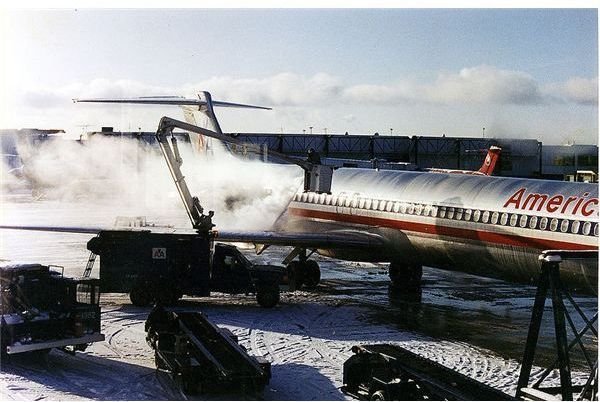
Above right: Aircraft Deicing on Ground. (Supplied by Newkai at Wikimedia Commons; Creative Commons Attribution; https://upload.wikimedia.org/wikipedia/commons/8/86/Aircraft _Deicing_Syracuse.jpg)
Reasons for Aircraft Icing Avoidance
When aircraft fly through clouds, particularly stratus and cumulus types, super-cooled water droplets impact the surface of the wings and airplane body. Although the ice is below freezing (32-degrees Fahrenheit or 0-degrees Celsius) it doesn’t freeze because there is nothing to which the water can attach. As the plane flies through the clouds, it uses the plane as a freezing material in a process called accretion.
The ice does not add any substantial weight to the aircraft, instead the ice alters the airflow along the surface of the wings and tail. Due to the fact that the ice changes the shape of the surface, the aerodynamics of airflow changes the lift and drag abilities of the vehicle. This condition can occur in as little as five minutes and affects both the performance and handling of the craft.
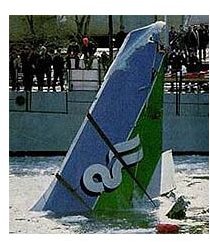
Safety programs for aircraft icing avoidance are taken very seriously by aviation experts and airline companies. A number of tragic accidents throughout the last few decades were caused by the condition, most notably Air Florida Flight 90, which crashed into the Potomac River in 1982, and Continental Connection Flight 3407, which crashed outside of Buffalo in early 2009.
Above left: Air Florida Flight 90. (Supplied by US Department of Transportation; Public Domain; https://upload.wikimedia.org/wikipedia/commons/0/04/Af90.jpg)
Resources
“Aircraft Icing” AOPA: https://www.aopa.org/asf/publications/sa22.pdf