Airport Security Screening History - Hijacking, Drug Trafficking and Terrorism Prevention Using the TSA and Full Body Image Scanners
Origins of Airport Security
Although the first aircraft hijacking occurred in 1931, it wasn’t until the late 1950s that airport security screening history took off. Despite warnings by professionals, threats were not taken seriously enough to install modern measures of prevention. By the late 1960s, hijackings were on the rise, culminating in an all-time record of 82 in 1969. Most of these involved demands for money or political goals. The first terrorist attack took place in 1976 aboard a Cuban flight, killing 73 people. Airlines and airports around the world began to institute more prominent security checks, most notably in the United States and Israel. Most of these measures involved metal detectors, X-ray machines and potential checks by private personnel hired as security officials.
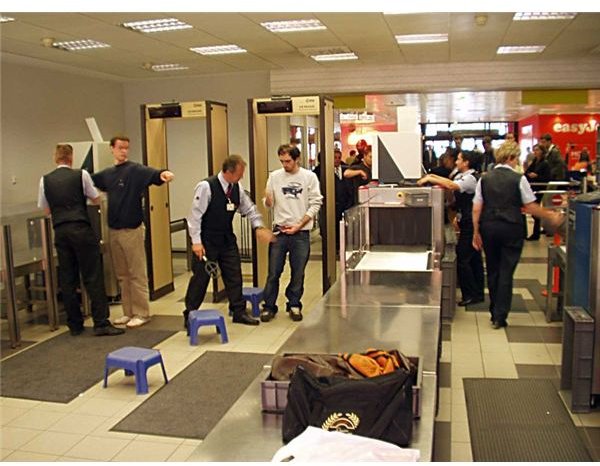
Above right: Airport security. (Supplied by Edward at Wikimedia Commons; GNU Free Documentation License; https://upload.wikimedia.org/wikipedia/commons/e/e7/Flughafenkontrolle.jpg)
Security Screening Tackles New Threats
Over the years, preventing hijackings became standard operating procedure and airline security focused on other forms of criminal activity. With the escalation of the War on Drugs in the 1980s, preventing the trafficking of illegal narcotics became a major focus. Drug-sniffing dogs and new pat-down procedures helped mitigate the transportation of these chemicals as well as other contraband. Still, through this time, the primary role of security personnel in the United States and around the world was limited to enforcement by private companies and the occasional law enforcement personnel.
History Changes
Following the events of September 11, 2001, airport security screening history changed drastically. When terrorists were able to hijack four passenger airliners and drive three of them into large structures, killing thousands, governments around the world responded with new procedures. In the United States, this resulted in the establishment of the Transportation Security Administration (TSA), a government agency that is responsible for all screenings of passengers at airports.
New rules were created about what could and could not be brought aboard airplanes. Box cutters and certain other objects that could previously be carried on board were now subject to confiscation. In addition, the newly-created Department of Homeland Security instituted the policy of secondary screenings of passengers and a No-Fly List of individuals in the country and around the world that would not be authorized to fly aboard airplanes.
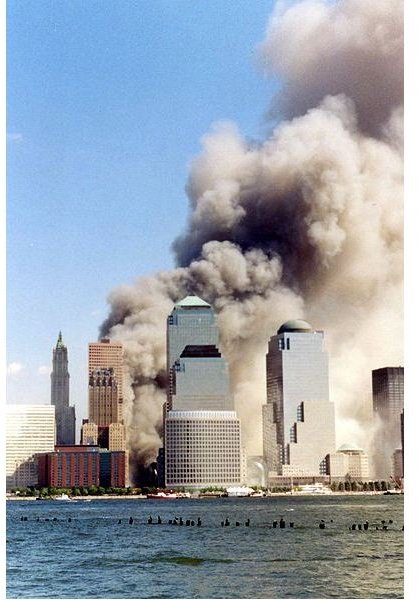
Above left: September 11, 2001 Trade Center Collapse. (Supplied by Wally Gobetz at Wikimedia Commons; Creative Commons; https://upload.wikimedia.org/wikipedia/commons/5/55/September_11_2001_just_collapsed.jpg)
Evolution of Airport Screening
In the subsequent years following the World Trade Center and Pentagon attacks, other terrorist attempts also prompted changes in airport security screening. On December 22, 2001, Richard Reid attempted to destroy a passenger liner from Paris to Miami using shoes packed with explosives. In response, passengers were forced to remove their shoes when flying on planes. In 2006, British law enforcement upset a plot to destroy airplanes using a combination of liquids, prompting officials to ban liquids over a certain volume on board airplanes. Likewise, Umar Farouk Abdulmutallab attempted a bombing aboard a flight from Amsterdam to Detroit on Christmas Day 2009. He smuggled the bomb aboard in his underpants. Following this incident, many airports began to install full body scanners.
Although airport security screening history began with a simple attempt at preventing political factions and individuals from seizing control of airplanes for personal gains, modern initiatives are focused more on protecting passengers and infrastructure from devastation. However, with the constantly changing war against terrorism and crime, it is only a matter of time before airport security screening history adds another chapter.
Resources
“Aviation Security” US Centennial of Flight: https://www.centennialofflight.gov/essay/Government_Role/security/POL18.htm
Transportation Security Administration: https://www.tsa.gov/
