Polarizing Filter Pros & Cons & Info on How Polarizing Filters Work
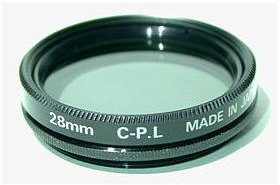
Polarizing Filters
You’ve probably read in magazines or seen on websites that the one most essential accessory any photographer should have is a polarizing filter. Most photographers would swear by one, and all photo-journals strongly recommend one. What’s the big deal with the polarizer, anyway? And if it’s so indispensable, why don’t camera lenses come with a built-in polarizing filter? Read on to learn the good, the bad and the ugly of the most valuable camera accessory of all times.
The Good
Light, like all electromagnetic radiation, has a wave nature. Apart from wavelength and frequency, another characteristic of light waves is their plane of rotation, or ‘polarization’. Normal light comprises waves polarized in various angles - vertical, horizontal and everything in between. Now, if we pass this light through a linear polarizing filter, all but one plane of light is cut off. The resulting light is devoid of interfering waves, and hence an image obtained through a polarizing filter appears without haze, giving the famous ‘deep blue sky’ effect.
The two images below illustrate the effects a polarizing filter can have on your photos (click any image to enlarge). The image on the left was taken without a polarizer, where the one on the right was taken with.


The Advantages of Using a Polarizing Filter
1. Water and other partially reflective surfaces often reflect a linearly polarized part of randomly polarized light much more strongly than others. Using a polarizing filter to block this off cuts off the glare and allows one to see beneath the surface of the water, which is fantastic if photographing aquatic life (just be sure you don’t get your camera wet!).
2. Removes haze and gives the sky a deep blue colour.
3. Makes the clouds ‘pop out’!
4. Cuts off reflections from glass, metals or shiny surfaces, like a sandy beach on a sunny day, giving clearer, glare-free photos.
5. Cuts reflections from surfaces like leaves or walls, making colours appear saturated, and shadows appear blacker.
6. Can be used as an effective ND filter (neutral density filter), especially in bright sunlight.


Notice how using the polarizer cuts back on the reflection of water and one can see beneath the surface too.
Photo credit: Mike Baird
The Bad
The Disadvantages of Using a Polarizing Filter
1. Nothing man made comes without its darker side (pun intended). The main disadvantage of using a polarizer is that it effectively cuts off almost 2 stops of light. You’d have realized it’s the flip side of point 6 mentioned in the previous page. The loss of 2 stops may not be an issue in bright daylight, but while shooting in dim light, dawn, dusk or while shooting moving objects, it can make a huge difference.
2. The effect of a polarizing filter is not uniform across the whole frame. The effect is maximal at an angle of 90 degree to the sun, and gradually tapers off on both sides. The non-uniformity is even more prominent when using a wide angle lens, which is what many people use for shooting landscapes.
3. At high altitudes, over-polarization may cause extreme darkening of the sky and photos may look unnatural.
4. Another issue of using a polarizing filter with a wide angle lens is that the polarizer is quite a thick a filter; its edges may block some incoming light, causing darkening of the corners of the photo, known as vignetting.
5. It’s very tricky to photo-stitch a panorama taken with a polarizer on. Each photo gets polarized differently and the final ‘stitched’ photo would have very unevenly coloured skies.
6. Linear polarizing filters often give focus errors with modern auto-focus cameras with TTL (through the lens) metering. The way out is to only use circular polarizing filters with such cameras.
7. Polarizing filters work best in bright sunny conditions. They’re not of much use in cloudy, overcast weather or indoors.
The Ugly
Well, there’s hardly anything ‘ugly’ about the polarizer, but one thing which does come to mind is when using lenses where the front element rotates while focussing, the polarization will change as one zooms. So one has to first lock the focus and then rotate the polarizer. This problem is eliminated with internal focus lenses.
In conclusion, the polarizer is surely one of the most useful of tools for any photographer, irrespective of his/her skill level. It forms an essential component of a photo enthusiast’s ‘magic box’ for getting stunning photographs! I’d strongly ask any person who doesn’t own this fantastic piece of glass to try one out as soon as possible. The ‘Good’ points of the polarizing filter far outweigh the ‘Bad’ ones!
