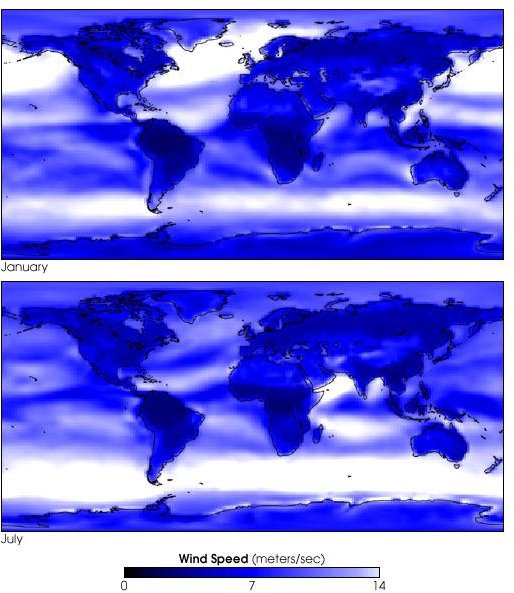
It’s all about wind- literally. Wind directly influences climate, which makes wind a central issue in the debate over climate change
All About Wind
Wind is the driver of climate. It not only serves to move heat around; the movements of masses of air also convey water vapor and particulate matter (pollutants as well as relatively harmless compounds) around the globe. Solar radiation is the engine of the atmosphere and the primary source of the energy in our biosphere. So, how does global warming (or climate change, if you prefer) affect weather in general and wind in particular?
What is climate?
Before we can discuss that with any depth, we need to have a working definition of climate. According to Webster’s online dictionary, climate is “the average course or condition of the weather at a place usually over a period of years as exhibited by temperature, wind velocity, and precipitation.” For our purposes, we’re most interested in wind at the moment, though temperature tends to affect or be correlated to wind and wind tends to be related to precipitation.
What is Wind?
The phenomenon of wind is caused by the movement of air from areas of high pressure to areas of low pressure. The greater the gradient (or difference) between these two air masses, the greater the velocity of the wind. Generally speaking, and as anyone who has watched a meteorologist’s weather report on TV can attest to, such areas are also generally associated with low (or high) temperature, respectively. Such systems are a result of air’s interaction with Earth’s surface, since land both heats up and cools off faster than air does. The earth stores and regulates the release of that heat in a controlled fashion dependent on the type of surface cover (soil, rock, snow, etc.). A classic example of this is demonstrated by birds- the thermals that they ride result from warm patches of ground causing convective heating of the ai;. sometimes, you will notice clouds associated with thermals as the water vapor in the warm air condenses as the air moves up the thermal. Ocean breezes are a result of the water’s lower density relative to soil or rock; because of this, the ocean heats up and cools more slowly than the ground, creating a pressure differential that results in a land breeze (one blowing in from the sea) during the day, and a sea breeze (one blowing out to sea) at night.
Stay tuned- Part Two of this series will discuss the intersection between climate change and wind.
Credits
Image courtesy of NASA