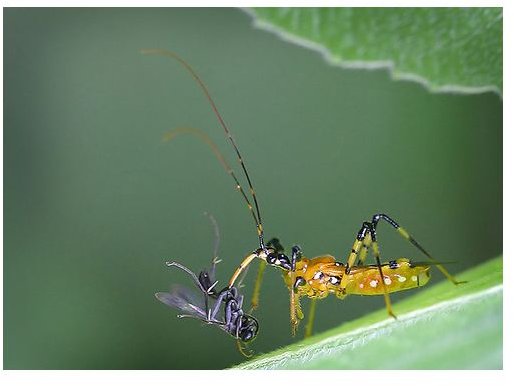
A brief look at the life of the assassin bug.
**
Description
The assassin bug has a long, narrow head with a sharp three segmented mouth, or beak. Four segmented antennae are long and slender. The abdomen is usually wider in the middle with attached wings. Adults can reach up to ¾ of an inch in length.
Most of the various species are dark in color with hues that include black, brown, red, and dark orange.
A number of species are referred to as assassin bugs and each has a slightly different appearance.
Habitat:
Assassin bugs can be found in meadows, gardens, and occasionally homes in a variety of locations but are most frequently found in the western portions of the Americas. They are also found in Australia.
Behavior:
Assassin bugs will lie in wait for their prey, waiting to ambush them. They will use their long and sharp beak to stab their prey and then inject a toxin that destroys the tissue. When the tissue has been liquefied the assassin bug will suck the liquid through its long mouth. This villainous method of acquiring food is what led to the name, assassin bug.
These are very aggressive bugs that will attack creatures much larger than themselves. If confronted with a human they will bite that can be quite painful and that can cause a severe allergic reaction.
Breeding:
Females produce between 40 and 80 eggs that are brown and cylindrical in shape. They may be placed individually or in clusters on the branches of plants or under stones. The eggs hatch between 14 and 16 days after being laid. Nymphs look much like the adults but are wingless. Nymphs turn into adults in about two months. They have a lifespan of about thirteen months.
Diet:
Assassin bugs prefer to eat other insects, spiders, and snails.
Miscellaneous
While the assassin bug is often considered to be a pest there are some studies that indicate it may be a beneficial as a form of pest control in cotton crops.
Scientific Classification
Kingdom: Animalia
Phylum: Arthropoda
Class: Insecta
Order: Hemiptera
Suborder: Heteroptera
Family: Reduviidae
Subfamily: Assassin Bug
Assassin Bug Photo Credit: B cool from Flickr, Creative Commons License