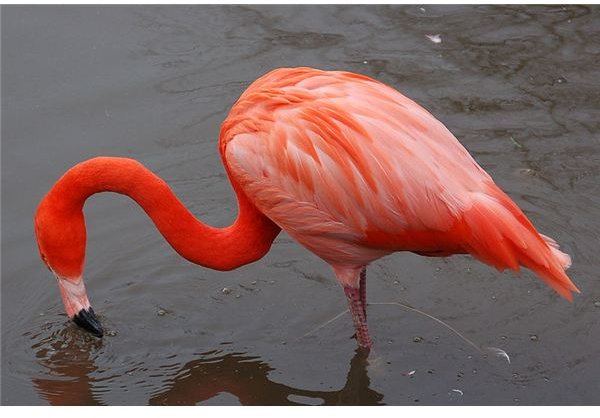
The long-legged, salmon-orange Caribbean flamingo is one of the most beautiful birds on the planet. While the long legs make them look clumsy and a bit off-balance, they are graceful and quite balanced.
Biology and Habitat
Caribbean flamingos are famous for their bright pink plumage (though they can also appear more orange or red). They are tall, slender birds that have long skinny legs that are dark pink at the knees. They have a black, curved, pointed beak and webbed feet. They grow to an average of 47 to 57 inches in height and exhibit sexual dimorphism with males being about 20 percent larger than females. Males typically weigh over six pounds and females weigh slightly over four and a half pounds. The wing span of the Caribbean flamingo spreads out about 4.9 feet.
There are four distinct populations of Caribbean flamingos. They can be found in northern and southern parts of the Caribbean, the Galapagos Islands, and the Yucatan Peninsula, in muddy flats, lakes, lagoons, and other areas of shallow water. Flamingos tend to prefer saltwater and are able to adapt their habitat to areas with better breeding grounds and better food availability.
Behavior and Reproduction
Caribbean flamingos spend most of their days preening, eating, wading, and resting. They are extremely gregarious birds, living in flocks of up to thousands. The flamingos make similar vocalizations to geese, loudly honking and screeching. During courtship, the call is louder, however it is quieter while feeding.
They put on several synchronized collective displays, like wing salutes, head flagging, head shaking, and marching. These displays are often performed during the breeding season. Caribbean flamingos have four main breeding sites, which are located in the Bahamas, Cuba, the Yucatan Peninsula in Mexico, Bonaire in the Netherlands Antilles.
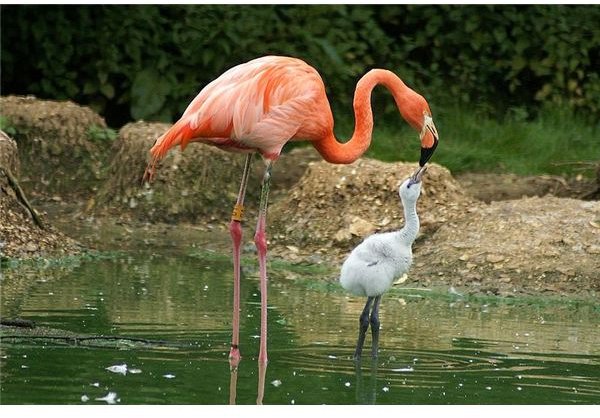
Flamingos first breed at three to six years of age and the breeding season is different for each flock. Flamingos form long-lasting relationships and pairs will breed for many seasons. They make nests out of mud that are formed into truncated cones. Incubation lasts about 28 days, with both male and female taking watch over the single egg that is laid. Upon birth, flamingo parents feed their chick a liquid secreted from their digestive tract that is similar to a mammal’s milk. This is often called “crop milk.”
Breeding in colonies, each male and female in the colony can produce the crop milk that comes from their upper digestive tract. This allows chicks that are in the colony without parents to be adopted by parents of other chicks.
When the chicks get old enough, they stick together. The adult birds watch over the little ones. By the time the babies reach three to five years of age they will have gained their adult plumage.
Diet
Flamingos are wading birds who sift through water for mollusks, crustaceans, algae, worms, and plants. They have bristles on their beak that strains the water from their food, similar to that of a baleen whale. Also, their tongue pumps water in and out of their mouth. Flamingos may skim the water for food with their beak, or use their beak to stab prey (like a heron), or dabble along the floor of a lagoon (like a duck). Often, they swish their beaks back and forth to allow the water to flow into their mouths, then let the bristles filter it. The tongue is used to push the water back out of their mouths, while holding the food in.
Conservation
There are several threats to the Caribbean flamingo population: the feather trade, lead poisoning from bullets containing lead, habitat loss and destruction, domestication (some zoos have captured wild flamingos), and disturbance to colonies from gawking tourists and photographers.
Caribbean and greater flamingos are now listed in the “least concern” category, meaning the species is widespread and abundant, according to the International Union for the Conservation of Nature and Natural Resources, or IUCN. The lesser, James’ and Chilean flamingos are under the “near threatened” category, which is a species that is close to being threatened in the future. The Andean flamingo is in the “vulnerable” category which faces a high risk of extinction in the wild.
The Caribbean, Chilean and greater flamingos are protected under the United States Migratory Bird Act of 1918.
Several projects are in place to protect the flamingos. With more than 300 flamingos in captivity, the Busch Gardens in Tampa Bay houses the largest flock of the species Caribbean flamingos in the world. Hialeah Park which is located near Miami, is a racetrack that is home to about 500 of the species. Hialeah Park has a lake with four islands which the flamingos nest on. The Flamingo Consortium was founded to protect the birds within their park if nowhere else. The Consortium passes these birds to other institutions which increase the population of the flamingos in captivity.
There has been great success in breeding the Chilean, Caribbean, and greater flamingos in Hialeah Park, SeaWorld, Discovery Island and the Los Angeles Zoo.
Scientific Classification
Scientific Name: Phoenicopterus ruber ruber
Kingdom: Animalia
Phylum: Chordata
Class: Aves
Order: Ciconiiformes
Family: Phoenicopteridae
References
- Image: Arpingstone, “Caribbean flamingo at Slimbridge Arp ”, under Public Domain license
- Author Unknown, “Flamingos ”, Animals: Explore, Discover, Connect
- Author Unknown, “Caribbean Flamingo ”, Philadelphia Zoo
- Image: Pettitt, Martin, “Caribbean flamingo5 ”, under CC BY-SA 2.0
- Author Unknown, “Caribbean Flamingo ”, The Animal Files