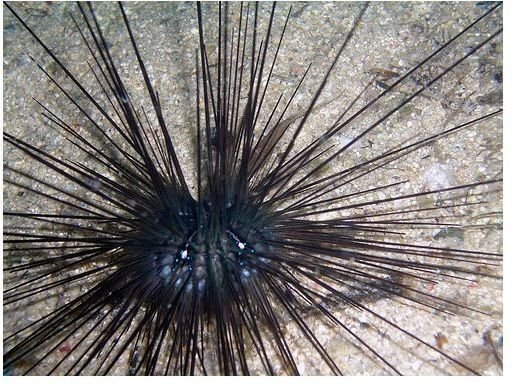
Humans and sea urchins are related even though we don’t look alike.
What is a Sea Urchin?
Sea urchins are echinoderms, marine animals that originated roughly 450 million years ago, and include brittle stars, sea cucumbers, sea stars, and crinoids. Urchins are easily overlooked in the ocean because they don’t have arms, claws, fins or eyes but are made of small, globular, spiny shells only 3-10cm across. They come in a variety of colors including black, shades of green, brown, purple or red. The spines protrude out of their shell, and protect the urchin from predators.
Urchins move slowly over what ever they attach to, using hundreds of transparent tube feet on the bottom of their shell. They feed mostly on algae but can eat mussels, sponges, brittle stars and crinoids. Left unchecked they can easily destroy their environment. Luckily sea otters, wolf eels and other predators feed on urchins and they’re considered a delicacy by seafood lovers.
How Could Sea Urchins Help Human Health?
Several characteristics make sea urchins good choices for research. They have strong immune systems and long life spans; some can live up to 100 years. And they’re very fertile; producing 20 million eggs at a time. Humans are born with innate immunity and also acquire additional immunities over time. Sea urchins only have innate immunity, with 10 to 20 times as many such genes than humans.Scientists hope that sea urchins will provide a new set of antibiotic and antiviral compounds to fight various infectious diseases.
“At a genetic level, ah, they’re actually related to us. So sea urchins and humans share a common ancestor,” Cristina Calestani, a developmental geneticist at University of Central Florida in Orlando, tells DBIS. “You really need a relatively simple system in order to study … but still, also you want it to be complex enough and closer enough to vertebrate in order to use this information,”
Calestani says.“Sea urchins are one of the few invertebrates on our branch of the evolutionary tree, that share more genes with humans than fruit flies and worms – and can be reproduced for research faster than other animals. That means researchers can produce a practically unlimited amount of material. And with a complete map of the urchin’s DNA, they can better understand how genes work, so when diseases like cancer strike, maybe doctors will know how to treat and even prevent them.”
To find out more about this research project, go to https://www.sciencedaily.com/videos/2007/0304-sea_urchins_reveal_medical_mysteries.htm
What is a Genome?
Scientists with the Sea Urchin Genome Sequencing Project, funded by the National Institutes of Health (NIH), recently completed sequencing of the genome of the sea urchin. A genome is all of the DNA found in an organism, including genes and DNA that don’t contribute to genes. The unique genome of the purple sea urchin is comprised of 814 million “letters” that code for 23,300 genes. Of those, the urchin has 7,000 genes in common with humans including genes associated with Parkinson’s, Alzheimer’s, and Huntington’s diseases and muscular dystrophy. And even though it lacks eyes, nose and ears, the creature has genes involved in vision, hearing and smell in humans.