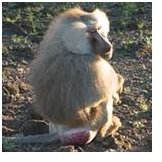
Learn about the omnivorous monkeys that live in communities.
Baboons are a large species of ground walking monkeys that inhabit wide areas in Africa and the Arabian peninsula. Average individual weighs 66 pounds and can grow up to 45 inches in length, not including the tail, which can extend to additional 22 inches. There are five species of baboons, all of which differ in size and appearance.
While fur can be of a brown, reddish, yellow, blackish or olive color, all baboons share the characteristic dog-like snout, and all males have canine teeth, which they display in conflict situations. Males of the biggest species, the Hamadryas Baboon, wear a white mane.
Habitat and Diet
Baboons live in East African savannas (in Kenya, Somalia and Ethiopia) and in the Arabian peninsula. They feed on grass, various seeds, fruit, roots and tubers that they dig from the ground. Baboons are omnivorous and will eat small animals, including lambs and antelope fawns. They are also known to raid crops.
Social Behavior
Baboons live in large groups called “troops.” A troop can include up to several hundred individuals, which interact and communicate between themselves in a variety of ways. Zoological research revealed a complex social structure and hierarchy within those baboon “communities.”
One alpha male usually dominates each troop. In larger troops, there are several dominant males, each ruling a harem of several females. While females rarely fight between themselves, males often challenge each other for the alpha spot or for the right to mate with other females. The dominant male usually gets access to the best food sources and will enforce his authority on other males.
Social activities include grooming – cleansing the fur and getting rid of pests – which helps to establish and strengthen bonds; searching for food, and treating and caring for the young. When in heat, females’ rumps swell and attract males, which begin to compete for the privilege to couple with the females. Upon reaching sexual maturity, young males leave the troop and attempt to join another.
Threats
Despite being hunted by humans, baboons are thriving: their adaptability, omnivorous diet and wide distribution contribute to their well-being as a species. Today, scientists study baboons in an effort to understand primate evolution.
Scientific Classification
Phylum: Chordata
Class: Mammalia
Order: Primates
Family: Cercopithecidae
Genus: Papio
Kingdom: Animalia