The combustion of wood logs as means of heating has been around for centuries. More recently a unique method of wood burning has evolved using pellets formed from sawdust. These are combusted in a domestic boiler with the heat produced used to heat the domestic and central heating water.
Introduction to Wood Pellet Production for Domestic Heating
Wood pellets are a relatively new innovation in the combustion of wood for heating purposes.
They are produced from sawdust which has been dried, and crushed before being compressed into uniform wood pellets.
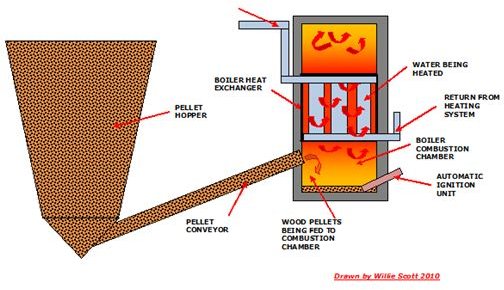
The wood pellets are automatically fed from a storage hopper into a pellet boiler where they are combusted, with the resultant heat being used for domestic water heating and the dwelling’s central heating system.
Although this is a relatively new system in the combustion of wood, it is already proved to be very reliable with efficiencies recorded in the lower nineties. Because of the high efficiency and renewable source of energy, most governments offer a domestic energy grant of up to 20% of the purchase and installation of a pellet burning heating system.
This is another article in the series on domestic use of renewable energy, and in this case we shall examine the processing of wood pellets used by a specialist pellet boiler. We shall also have a look at the storage and supply of the pellets to the boiler.
We begin then with the processing of the sawdust into wood pellets.
The Production of Wood Pellets
Wood pellets are produced from ordinary sawdust which can be found at any sawmill throughout the world. The sawdust is delivered to the pellet production plant and is normally stored undercover in a building like a Dutch barn which allows air to circulate through the sawdust stacks.
From here it is conveyed under a magnetic field, this unit removing any traces of ferrous metals moving on and entering on into a rotary kiln. The kiln removes most of the moisture from the sawdust, leaving it with a moisture content of around 8%, which being a low value is more energy efficient.
From the kiln the sawdust passes through a filtration unit which removes the fines (regular checks for fines are carried out during the processing stages) before being conveyed into the hammer mill.
The hammer mill crushes the sawdust into fibrous strands and from here the woody matter is fed into numerous molds where it is compressed under very high pressure. The molds produce a pellet of 6mm diameter with a length of 20mm which is of high density, durable and consistent quality.
The pellets are then cooled and once again subjected to filtration for removal of any loose fines. It is obvious that the pellet manufacturers are pretty strict in controlling the amount of fines contained in the pellets. This is for two reasons- the fines can impede the smooth flow of pellets to the boiler and, they can cause irregular burning of the pellets in the boiler, causing fluctuation in the combustion process.
The pellets are then bagged and palleted for delivery to the wholesalers.
The Wood Pellet Boiler Operation
The pellets are supplied to the boiler by a small covered conveyor running from the bottom of the hopper to boiler combustion chamber. Initially the pellets are fired by an automatic igniting component in the combustion chamber, which can be used as required.
As the domestic or central heating calls for more heat, the conveyor speed is increased, the combustion air fan supplying optimum air to match the increase in fuel requirement.
The ash produced falls down into the ash-pan, which depending on the fuel consumption only requires to be emptied two or three times a week.
The ash is good quality potash which can be added to the soil in the garden.
This wood pellet burning boiler is one of the best examples of the use of renewable energy for domestic heating I have examined.
I used to live in Aviemore, a small village high up in the Highlands of Scotland. We had very cold, snowy winters, and I investigated the pros and cons of installing a pellet boiler to my existing system.
I visited the local agent for the pellet boilers and saw one in operation. The agent had installed this boiler in a room he used as his home office. I was very impressed with the quiet operation of the system, only the odd tinkle from the conveyor, taking the pellets from the hopper which he had fitted to an adjacent cupboard.
He invited me to open the furnace door, which revealed a bright blue flame of intense flame.
I moved house shortly after this and my present heating system is from a gas condensing boiler. However if I ever have to change the system boiler I would give the wood pellet burning boiler very careful consideration.