A Wind Amplified Rotor Platform has several unique features which makes it a better choice as compared to a conventional wind turbine. Find out the reasons in this article!
Introduction
This is the third article in this series of the relative comparison between WARP units and Wind Power Plants. In the first article we learnt that WARP units occupy far lesser space as compared to conventional wind turbines, while in the second article we learnt about the advantage of height that WARP has to offer. In this article we will compare the noise levels of these two types of wind machines.
The Silent Noisy Machines
Normally a conventional wind turbine is said to be a silent and clean producer of electrical energy and it is quite true to a great extent. A wind turbine is silent if you compare it to the rumblings of a two or four stroke engine, but after all a wind turbine consists of huge rotors which are rotating at a considerable RPM in air, so it is bound to produce some noise. If you haven’t seen an actual wind turbine, just think about the ceiling or table fan in your home or office and just imagine how much more noise would a turbine produce.
If you have read, I wrote an article recently on the effects of this whoosh-whoosh noise and how it is leading to breaking up of many families. If you haven’t read this article, just click here to read it. Of course we all may not be so sensitive to noise pollution but this case certainly proves that noise levels also matter a lot and in this comparison the WARP is certainly better than a conventional wind turbine.
Any noise from an industrial unit or machinery can be classified as near field sound levels and far field sound levels. I think the terms are self explanatory and refer to the levels of sound in the vicinity of the equipment and at a certain distance respectively. In installations such as wind turbines and WARPs, it is the far field sound levels which should be taken care of so that the nearby communities are not affected in a manner as described in above mentioned article.
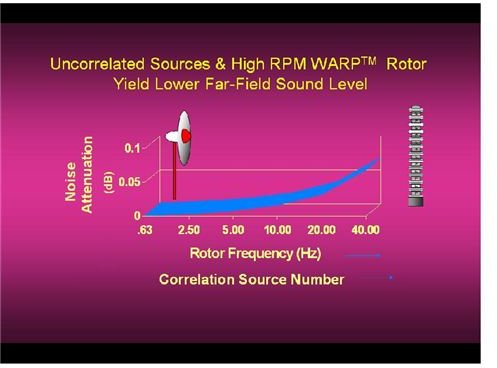
Just see the graph in figure 1 which shows a comparison between noise attenuation levels and rotor RPM of a conventional wind turbine as well as a WARP unit. Do not bother about the correlation source number shown along the horizontal axis at this stage. If you are not able to fully comprehend the graph, it simply goes to show that the far field sound levels of a WARP unit are lesser than conventional turbines.
Hence we see that apart from saving space and utilizing height in a better way, the noise levels are also lesser with WARP installations. In the next article we will see some more features and comparison between them. Although the difference between sound levels may not be extremely large but still people like Yancey would certainly prefer to have such WARP units instead of conventional wind turbines, so as the reduce the bitterness in the winds.
Figure 1: WARP vs Wind Turbines
References
Figure 1: WARP vs Wind Turbines (Courtesy: Eneco Corporation, Texas)
Suggested Readings
WARP vs Turbine: Comparison of Wind Power Plants – Part I
WARP vs Turbine: Comparison of Wind Power Plants – Part II
WARP vs Turbine: Comparison of Wind Power Plants – Part IV