Learn About Rammed Earth Building Technology
Using Rammed Earth for Building
Introduction
Rammed earth building technology has been around as long as the Great Wall of China, in fact part of it was constructed using these actual building methods.
The mixture used for building construction comprises of portions of sifted soil, sand, gravel and lime with water added to produce a soft pourable mix.
To construct the building walls, the mix is poured into a formed framework and rammed tight using a hand tamper or a mechanical driven one, until the mix is compressed to about half its original depth. The operation is then repeated until the walls are of the desired height and length.
This is my third article in a series about natural green building materials, and as before, it is not written as a specific construction guide, but as a description of the different methods and materials used in green building construction.
We shall start by having a look at how the material is mixed, which is the first stage in rammed earth building technology.
The Materials Used in Construction
The construction material is prepared by mixing quantities of the following items,
- Clay – any excavated or surplus soil from the building plot can be used after sifting. Don’t use the topsoil. keep this for your lawn and veggie garden. Soil makes 65% of the mixture.
- Lime or ox blood – this acts as a stabilizer bonding the items together. These stabilizers are much more environmentally friendly than the conventional cement bond used by some builders. The stabilizer makes up 4% of the mix.
- Gravel – fine gravel is added to give further stabilization and bulk to the mix. This is just a couple of handfuls, about 1% of the mix
- Sand – this is the major ingredient of the mix and is added to improve the walls’ insulation properties as well as adding bulk and improving the quality of the finish. The sand makes up the remaining 30% of the mixture.
This is just a guide, check with the local Rammed Earth Builder for the optimum mix for your area, some of whom recommend the addition of cement to create stabilised rammed earth (SRE)
Framework
This is constructed to the desired width and shape of the building walls. Its purpose is much like that of concrete shuttering, being a frame into which the mixture of earth and sand is poured, and maintaining the shape of the frame when set.
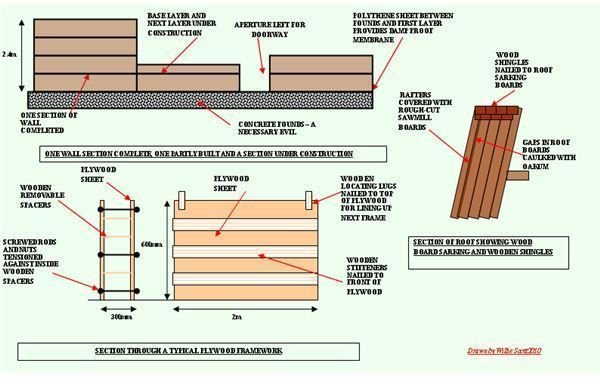
The frame we shall use is constructed from plywood reinforced against bowing with horizontal stiffeners of strips of wood.
The gap between the plywood framework which dictates the width of the wall is maintained by the use of wood spacers which are removed as the mixture is tamped down. Finally, a couple of lengths of screwed rod with nuts and flat washers bolted between the two sheets of plywood compliment the horizontal wood stiffeners. These are removed as soon as the mix has set.
A couple of sets of strips of ply are nailed to the top outside edge of the plywood to facilitate fitting up with the frame above, thus ensuring an even surface finish to the wall’s vertical sections.
The framework is usually 2m long by 600mm high (dimensions of a standard sheet of plywood) by 300mm wide.
Foundations
A concrete foundation is poured and when set, covered with a wet proof membrane of polythene or thick plastic sheet upon which the first layer of the wall is laid.
These are all approximate quantities and one of many different ratios of the components used to prepare the building material of construction.
Method of Rammed Earth Construction
The method of rammed earth construction hasn’t changed much over the years and we will start with the construction of the walls.
Wall construction
The framework is built up as described in the previous section and set on top of the foundation wet-proof membrane.
The mixture is poured into the frame to a depth of about 200mm, right along the frame length, and then compressed using a tamper. A tamper can be purchased or fabricated from a flat piece of steel plate with a vertical rod welded to the center of the plate.
This is used to pound the mixture from top down, either by hand or a mechanical means until the mix is compressed to half its original height, removing the inner stiffeners as they appear.
Several more layers are laid using the same procedure until the frame is all most full. The screwed rods are removed and the wall is then left for a few hours to set.
During this time another identical frame is laid firmly and accurately on top of the original one, located using the wood guides.
This procedure is continued until the required length and height of the wall is attained when it is allowed to dry out.
Window and door apertures are left in the walls, by using end shutters where required.
Once the walls have dried out, they can be wire brushed to a gloss finish, and given a couple of coats of specialized earth - wall weatherproof sealer on the outside surfaces to complete the project.
Thermal insulation may be required and this is attached in the normal way by strapping the inside walls.
The Flooring
Rammed earth buildings should have a compacted floor of the same material, which again can be wire brushed by hand or polished with a machine to bring up the finish.
A wet-proof layer of polythene sheet may be required between the soil surface and the compacted earth floor.
Windows and Doors
In order to keep our rammed earth construction environmentally friendly as possible, recycled doors and windows can be used.
Roof Construction
The rammed earth walls will support a roof, provided light materials are used for construction and weather proofing. A typical roof is shown in the drawings section below.
Summary
We have seen how to build a house using rammed earth technology. This is a centuries old, tried and tested method of using natural green building materials as featured in my previous articles on the use of straw and wood logs as construction materials.
The rammed earth buildings have been seen to last for hundreds of years, the Great Wall of China having incorporated a few sections of this material and still standing.
The walls are constructed using a mixture of clay, sand, gravel and lime to which water is added. The resultant mix is then poured into wooden frames and tamped down until well compressed. The frames are portable and reusable and the process carried on until walls of the required height are constructed. Rammed earth walls are about 300mm thick and have high thermal mass to soak up and retain solar energy.
The floor can be laid with the same mix of materials that the walls are constructed from and the roof is adequately supported by the thick walls. The doors and windows can be bought from a builders recycling yard.
This type of house is labor intensive, but simple to construct so you can rope in lots of friends for wall-building parties. The normal services of water, gas, and electricity will have to be carried out by an authorized craftsman, as will the roof and ceiling installation. Apart from that, it should be easy enough for the DIY person to tackle building a house using rammed earth technology.
Rammed Earth House Construction Drawings
Internet Sites Visited
This post is part of the series: Green Construction Materials
Here we look at different green construction materials and rate their durability, insulation capability, aesthetic qualities and more. We will take a closer look at using materials such as logs, straw and rammed earth, and adobe, as well as the use of recycled building materials.
