You have heard the buzz about cloud computing and how it is transforming the modern information technology (IT) landscape. As service-based IT grows in popularity, you need to understand its components: Software as a Service and Infrastructure as a Service (IaaS). Here we explain the basics of IaaS.
The key aspects of IT infrastructure, hardware, facilities, and administration have traditionally been the domain of IT departments
within each company. Dedicated personnel install and configure servers, routers, firewalls , and other devices in support of their respective employers. This equipment requires dedicated housing as well as environmental controls, emergency power, and security systems to keep it functioning properly. Finally, every company allocates additional space where IT personnel work to support the infrastructure that is in place.
Every aspect of IT infrastructure has evolved on its own, yet - until now - has not moved toward integration. For example, a company purchases software it needs and then purchases a server to run it. If data storage is necessary for files or databases, disk arrays and hard drives are added into the mix to accommodate the needs of the company. A local network is maintained to provide employees access to IT resources, and high speed internet connectivity for voice and data is added to the company account as necessary. Practically speaking, each IT system has its own management system, with some systems requiring the addition of a specialized worker to the staff.
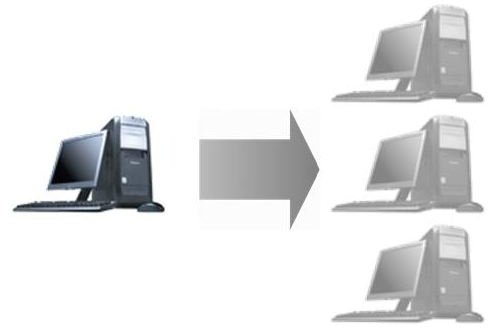
Infrastructure as a service takes the traditional components of IT infrastructure, takes them off site, and offers them in one unified, scalable package to companies who can manage them through one management interface.
Image Credit: Wikimedia Commons /Cqq
The Benefits of IaaS
Infrastructure as a service results in IT services that easily conform to the changing requirements of a business. Because the infrastructure does not reside on the premises, obsolete equipment, upgrades, and retrofits no longer play a role in the company’s decision to adopt new technology: the IaaS provider takes care of that seamlessly, allowing the business to focus on its mission.
Cost effectiveness augments the convenience of IaaS. Because the IaaS provider has massive platforms segmented for each customer, the economies of scale are enormous, providing significant cost savings through efficiency. The need for every company to maintain its own infrastructure is eliminated through IaaS.
The power of IaaS brings the resources needed to service government and enterprise contracts to businesses of every size. IaaS improves reliability because service providers have specialized workers that ensure nearly constant uptime and state-of-the-art security measures.
Virtualization
Virtualization as an alternative green technology has paved the way for infrastructure services to become a reality. Virtualization removes form factor considerations from IT services because servers of any type and size can be configured to run on generic infrastructure. This means that virtual servers can easily scale to larger or smaller capacities and utilize more or fewer resources on the fly. Processors, memory, software, firewalls, and other resources can change in real time as the needs of the customer change. Meanwhile servers from different customers can reside on the same service provider platform, providing for incredible efficiency in space, hardware, and manpower.
IaaS providers offer customers varying degrees of administrative latitude over their infrastructure through a unified Web portal.
The Bottom Line
Infrastructure as a service continues to grow in popularity because of its impact on the bottom line of every business. IaaS provides for the budgeting of hardware costs.
The reduced down time of IaaS, its security and application in disaster recovery plans , and its responsiveness mean that businesses gain through the availability of more productive time.
As environmental consciousness becomes a mandatory part of every business model, IaaS helps the green initiative by addressing power utilization requirements and by handling other matters such as the proper disposal of old hardware. Some businesses may even qualify for tax breaks by adopting IaaS.
Perhaps the most significant impact of IaaS to the bottom line of a business is the savings in labor costs. Through IaaS, businesses can eliminate the bulk of their IT staff, paving the way for massive savings in salaries, taxes, as well as health insurance and other benefit costs.