Understanding the European WEEE directive
Introduction
The European WEEE Directive has the goal of managing electronic waste. The full-form of WEEE is “Waste Electrical and Electronic Equipment” which clearly identifies its scope. This kind of waste is also sometimes referred to as e-waste. The WEEE directive seeks to set up collection, recycling and recovery targets for electrical and electronic equipment, in order to reduce the incidence of e-waste and related environmental problems. The WEEE directive is closely related to another EU directive called RoHS (Restriction of Hazardous Substances).
The Problem of e-waste: Why is such a directive needed?
E-waste is a problem and its growth will be obvious if you look around your own home. You’ll likely find broken or unused mobile phones, non-functional cordless phones or handsets, routers with antennas in tatters, bricked routers (i.e. those that you tried to install Linux on, or tried to update the firmware, but something went wrong,) an old TV in the basement and so on. Some reasons for the growing volume of these is that electronics are literally dirt-cheap these days (some of those cordless phones and routers come for $20-$30 or less.) Besides, many things become obsolete very quickly. Of course, to a large extent this obsolescence is well-planned. The corporations selling you electronics want to keep selling to you.
E-waste often contains a number of toxic and/or carcinogenic substances such as lead, mercury, cadmium, polychlorinated biphenyls and more. If these make it to landfills then eventually the toxins can find their way into food and water supplies. Therefore, it is not surprising that this proliferation of e-waste needs to be controlled. In some ways, here is an example of a government actually acting much sooner than they have in many other situations (consider the history of other toxic waste.) That certainly is a good sign.
What the directive aims to do
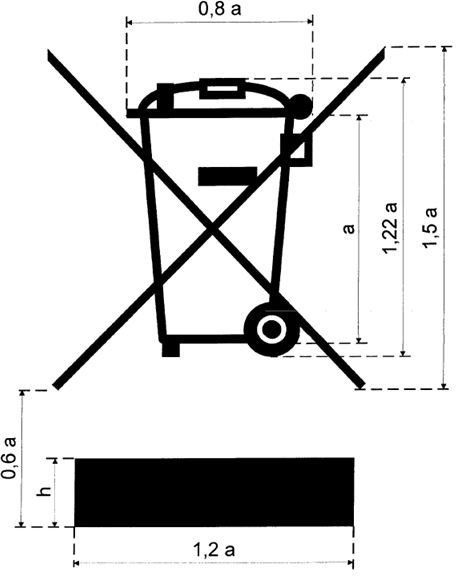
One interesting aspect of the directive is that it puts some of the responsibility on the manufacturers themselves. Since planned obsolescence is what leads to the problem in the first place this seems only fair. The current version was adopted on January 23, 2003. The directive specifies that equipment falling in one of 10 categories must always carry the WEEE Symbol. The WEEE Symbol shows a trash can (see below) indicating that the item should be dealt with differently, rather than placing it in the trash bin. Other goals include prevention, reuse, recycling, recovery, disposal and treatment initiatives in order to manage e-waste and minimize the effect on the environment.
The WEEE directive requires countries in the EU to implement legislation to achieve all the goals of the directive. But there hasn’t been as much legislation as expected. Of the legislation that is there, for collection and recycling, there still is only about a third of the e-waste that is being marked as “appropriately treated”. This has led to the need for an overhaul of the WEEE directive. Nevertheless, a third is better than nothing, and hopefully the situation will continue to improve, especially if a new directive goes into effect.
Initiatives in the US and what you can do
In the US such management comes under the purview of green computing initiatives. In many cases, however, “green computing” is just a buzzword being used by corporations to boost sales. As a citizen one needs to be aware of what exactly the “green computing” initiatives are.
At present, there are 26 states in the US that have initiatives for the recovery and recycling of obsolete electronics. Some green computing initiatives put the emphasis on trying to get things done more efficiently, so that, essentially computers can be usable for a longer duration of time. Perhaps even more than a decade. Re-purposing and donating to others (especially to charities and non-profit organizations, who may not have a need for heavy computing in the first place) are other initiatives. Obviously, as a user looking to get rid of your old computer, this can be as easy as looking for this type of organization, and you can also put up ads on your local classifieds. The freecycle project is something to consider. Finally, try to be aware of local recycling initiatives and try to contribute in some way. These days one can often see drop boxes for old mobile phones and out-of-juice batteries – start there!
