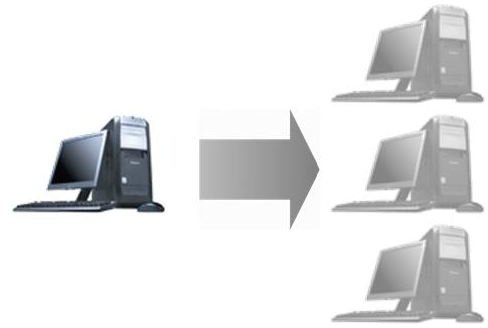
Virtualization is the leading technology that is sweeping the IT industry. Technologies that allow multiple computers to run on each set of computer hardware have matured, allowing for dramatically lower costs with amazing gains in efficiency. Learn more about the advantages of virtualization here.
Overview
Two of the leaders in server virtualization , VMware and Microsoft, have revolutionized the way we think about IT by making it possible to
emulate hardware platforms in a software environment. Virtualization has matured to the point where server clusters can be scaled to share memory and CPU resources seamlessly across hardware platforms to efficiently utilize hardware resources to support growing numbers of virtual machines. Learn more about the key advantages of Virtualization here.
Image Credit: Wikimedia Commons/Qingqing Chen
Environmental Benefits
In a world where political forces seem bent on saving the world from either real or imaginary threats of global warming and climate change, corporations are pressured to reduce their carbon footprint and the impact their activities have on the environment.
With all the publicity and controversy surrounding environmental activism, many people seem to associate “green” initiatives with mountains of government red tape and increased cost. Although this may be true in some industries, virtualization offers tremendous benefits when best practices are used not only for the corporate bottom line but also for the conservation of the earth’s resources. The “green” benefits are primarily twofold.
First, virtualization reduces the amount of physical hardware needed to run an IT operation. From data centers to enterprise servers, a single modern server can now run several virtual servers, sometimes with higher performance than they would have if each server was on its own hardware platform. This benefits the earth because less raw materials and electricity are used in the production process.
A lower number of total hardware units means less fossil fuels are needed to warehouse and transport server hardware. Finally, fewer hardware platforms in service means that fewer machines end up in landfills where they take up space and potentially leak dangerous chemicals.
The other environmental advantage of virtualization comes in the form of reduced energy requirements. Especially with so-called “cap and trade” regulations being implemented by the government, energy costs are skyrocketing, making data centers and IT divisions a flash point for runaway costs. Through virtualization, fewer hardware servers are required to support a growing number of virtualized servers, reducing overall energy consumption. Furthermore, servers optimized for virtualization are now commonplace, implementing the latest power management technology to reduce the environmental footprint of IT.
Cost Reduction
Troubling economic times have made corporations scale back, fueling the trend for the latest in virtualization technology . The reduced number of of physical servers in the data center means that less equipment needs to be purchased, resulting in lower costs. Reduced energy requirements lower power bills, adding even more cost savings into the mix. Furthermore, virtualized IT departments take up less physical space, allowing companies to either operate in smaller quarters or to utilize more of their space in support of their business mission.
One of the less publicized advantages of virtualization is that of less manpower. Although the administration of virtualized enterprises is more specialized, requiring more compensation for staffers, the ability to dramatically reduce IT payroll costs cannot be overlooked. More servers than ever before can be managed by one person, meaning that a growing number of high salaries can be sliced from corporate payrolls. Hardware maintenance, software updates, security, and other routine IT tasks are consolidated together with the virtual servers, reducing the need for even the lowest tier of IT workers.
The ability to do more with less is always welcome in the business world, and is a compelling reason that justifies significant investments in virtualization around the world.
Summary
Virtualization is no longer an emerging technology. It is a mature and practical technology that substantially addresses corporate “green” requirements while aggressively reducing operating costs.