Once upon a time SLR cameras came with form fitting leather cases that usually prevented more photos from being taken rather than helping make images. Photographers looking for something in the way of improved camera protection these days have a better choice.
Replacing the Never-Ready Case
Once upon a time, SLR cameras came with a protective leather case that wrapped around the camera body and standard lens and offered the camera at least a little protection from dust and moisture . Unfortunately, these “Never-ready” cases, as they eventually became known, often did more to get in the way of a good photograph than they did to do anything to help make one.
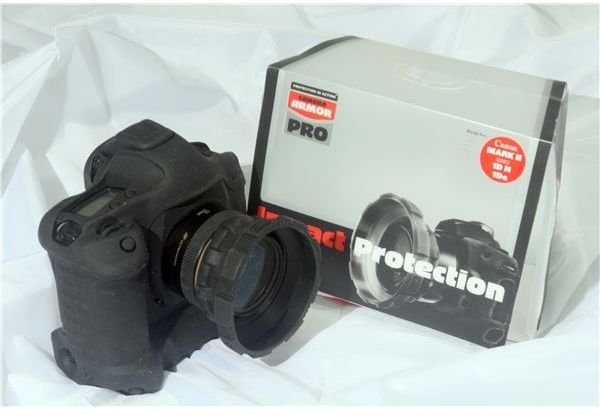
The old leather “Ever-ready” case (as camera makers preferred it be called) is as much a thing of the past these days as a film leader extractor, but the idea of a form-fitting sheath to protect the camera body isn’t. “Camera Armor” is a new take on the idea of keeping your camera a bit safer through a protective covering, but with the added twist of making your important controls available without having to remove it (avoiding the whole “Never ready” issue).
Camera Armor
Product Design (4 out of 5)
The product is made of a transparent “specially engineered” silicone (quote is from the company’s website) designed to provide shock absorption and protection from at least some of the elements as well as dust and fingerprints. It is not designed to be a waterproof covering and not to be relied on to keep the camera dry in the rain (although the camera will be better protected with it on than it will be with it off). It will do a good job of protecting the camera from bumps and dust.
Operation (3 out of 5)
Using it: Camera Armor comes as a multi-piece setup. I received one for testing from the company for my Canon EOS 1DmkIIn camera when I was writing a David Busch Quick Snap Guide to Photographic Equipment. The Camera Armor is not a one-size fits all device, you have to make sure you order one specifically for your camera, check the company’s website to see if your camera is covered. My kit included the basic silicone sheath for the body, a protective plastic cover for the LCD screen, and a silicone “Lens Armor” attachment that mounted on the end of my lens and also provided some service as a lens shade (albeit, a small one). The Lens Armor fits most lenses with a filter size from 52 mm to 77 mm. A lens cap leash also comes with the kit.
How well does it work? Well… it’s a huge improvement over the old leather cases, but I still had some problems. Squeezing the silicone sheath over the camera’s body was a bit of a challenge (but then it probably should be for a tight seal). I was able to access various controls and buttons, but couldn’t always get them to work. This became a problem at times (for instance, I couldn’t activate the review button no matter how hard I tried). The armor certainly did seem to offer shock and dust protection and the Lens Armor certainly added a bit more for the lens too. I’m just not sure I’d want to spend the day trying to shoot a soccer tournament or some other event with it on. Since I also shoot in the studio a lot (and definitely wouldn’t want to use it in there), I’d also be removing it and putting it back on often enough for the routine to become a pain.
On the other hand, I once shot a National Guard exercise in the Arizona desert and was photographing a helicopter landing that blew up a ton of sand into my camera and me. Camera Armor would have been a huge help for that shoot! And that may be its best niche. As an added bit of protection for the occasional extreme shoot, Camera Armor could represent a low cost bit of added insurance for your camera.
Price to value (3 out of 5)
Since the price for the Camera Armor kit ranges from $24.95 to $69.95 and up depending on the camera you’re buying it for, you can feel like you’re getting a pretty good value for your money, provided the product does what it’s supposed to and its functionality meets your needs. It really comes down to how often you’re going to need the added protection it offers and your willingness to fit it properly to you camera.