The first key activity you will undertake for your PhD is to find out what other people have already found out about your topic. Found out how to do it, and how computers can help you and hinder you.
Reviewing the Literature
The purpose of a literature review is to establish the current state of knowledge before you start your PhD study. There are probably three stages in most reviews. First, find your information. Next, appraise what you have found for relevance and robustness. Finally, synthesise your findings into a set of collective conclusions. Computers and the Internet have made finding information much easier than it used to be. However, they haven’t necessarily made it easier to find the right information. Nor have they made it easier to actually review the information once you have found it, or to synthesise your conclusions
What Information Are You Looking For?
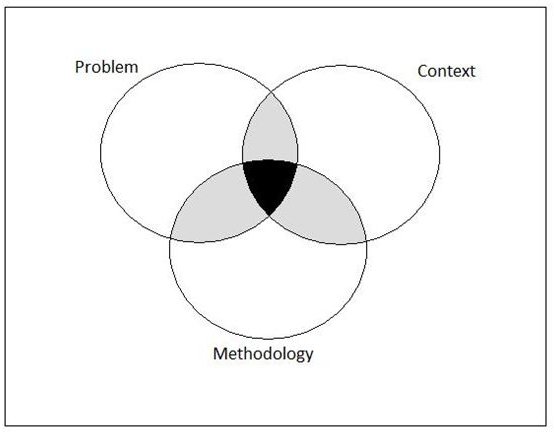
The starting point for any literature review is the problem under investigation. However, in many cases, there is more to it than that. Very often, I suggest that students should look for literature on three things:
- The problem under investigation
- The problem context
- The problem methodology
Papers that relate to more than one aspect are especially relevant. Think of a Venn Diagram. Each category is represented by a set, the intersections of each set are the most relevant and useful. Thus, if you find an article that investigates the same problem using the same methodology in the same setting or context, that can be the most helpful.
How Are You Going to Find It?
Information is easier to find than it used to be but there’s still more to it than putting a few keywords into Google. There are a range of specialist bibliographic databases each dedicated to a specific subject domain. Thus, in health, there is MEDLINE covering the medical literature, and CINAHL covering the nursing literature. These databases are usually accessible online from University libraries for students. They will only give you access to the abstracts and citation details, but again, your University library can provide access to many journals in electronic and/or paper form.
There is a version of Google designed for scholars, called Google Scholar, which is designed to search the academic literature. Its advantages are that it is very good at finding information because it uses Google’s search engine, and it is not limited to one subject area, which can be particularly important for interdisciplinary studies. On the other hand, it is dynamic and opaque, because Google will never tell you exactly what it searches and how it does it, so it is not entirely satisfactory as an academic tool.
A key issue is making sure that you use the right search terms. You need to make sure that you use the same terms as the authors of the papers you wish to find. In some disciplines there is an agreed systematic search terminology. Where this exists, for example, the MESH structured terminology in medicine, you should be using these search terms.
Another traditional way of finding articles to look at those articles cited by the key papers you find. These are by definition, older papers. However, many e-journals, often offer the added facility of articles that have cited the article you are currently reading.
Finally, just because there are computer tools available to help you, never forget that human librarians are trained in search. I guarantee that they will find things that you will not.
How Are You Going to Review It?
A Literature Review is not just a list of the available articles on the subject. It is a review of the findings and quality of individual articles as well as a synthesis of the resulting knowledge.
There are useful sources to help you do this. Greenhalgh provides an evaluation framework based around five questions for quantitative medical studies:
- Was the study original?
- Whom is the study about?
- Was the design of the study sensible?
- Was systematic bias avoided or minimised?
- Was the study large enough, and continued for long enough, to make the results credible?
She provides supplementary questions to explore each of these aspects in this context. More generically, we can consider the methodological quality, the relevance of the setting and specific question considered in each article.
Having decided which articles provide relevant and robust prior knowledge for your own study, you need to synthesise their findings to answer the final question: what does this body of knowledge tell me about my study? The answer may require you to revisit your research question, scope or methodology.