Guidelines for detecting plagiarism, researching suspicions of plagiarism, and validating or disproving plagiarism allegations that online instructors can use. Clues that can be used to identify cases of plagiarism and a recommendation for documenting the incident and what materials should be kept.
Plagiarism Detection: An Instructor’s Responsibility
Part II of this series focuses on detecting plagiarism and validating or disproving the suspicion. It occurs to me how dour this subject is when examined from purely a punitive angle but taking action is essential if students are to understand the serious nature of these violations. Instructors that take a laissez faire attitude are doing positive injury to their students, their school and to the author whose material has been used. My personal view on the issue is that instructors are obliged to prevent plagiarism as part of an effort to maintain the integrity of their classes.
A certain number of students are going to try to get away with plagiarism so I employ a set of guidelines to spot plagiarism offenses. I assume that all students are writing their own material and adhering to the academic rules and requirements of the University which I think is important for maintaining a healthy view of the student population. This assumption also frees instructors to celebrate the growth of their students’ ability rather than look upon such improvement with suspicion. After all, students should demonstrate improvement while attending college courses and naturally instructors should be facilitating that growth. The point is that students should be given the benefit of the doubt and allowed to make improvements without being suspected of something improper.
Plagiarism Clues and Detection Techniques
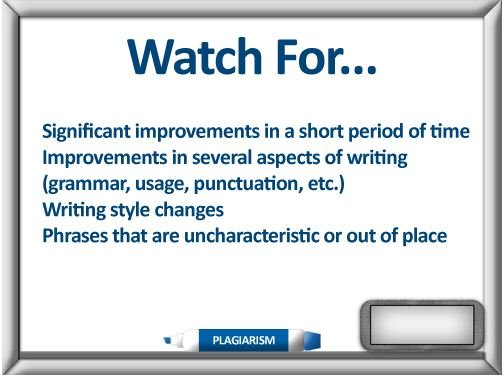
Assuming that students are following the rules and looking for plagiarism may seem to be contradictory functions. However both can be satisfied if instructors will simply be on the lookout for clues that hint at impropriety. Here are some clues to watch for that may indicate plagiarism:
- Significant improvements in a short period of time
- Improvements in several aspects of writing (grammar, usage, punctuation, etc.)
- Writing style changes
- Phrases that are uncharacteristic or out of place
When I suspect plagiarism I follow a specific plan of action.
- Originality search using the school’s plagiarism checking resource (e.g., C4P , Turnitin® )
- Internet search
- Electronic text search
A technique I recommend when conducting an Internet or text search is to select a three or four word phrase from the student’s paper that seems particularly suspect. Searching for these phrases helps catch plagiarism that consists of rearranging words and phrases from a specific source. I spend five to ten minutes on a suspicious paper and then move on. If I cannot establish that the student has committed a violation in that amount of time I drop the suspicion of plagiarism. Having a time limit helps me keep my commitment to divide my time fairly among my students.
In cases where I can identify the original source the student has used to commit plagiarism I create documentation for my protection. I create a file on my computer for the situation and document my findings with electronic copies of the paper, the source document, the report from the originality software (as applicable) and a memo that explains what was suspicious and what I did as a result of the clues in the student’s paper. With the situation fully documented it is easy to take the appropriate actions that I describe in the next installment.