Try this fun project with your kids. Make your own remote controlled boat!
Teach your child a few basic principles of electricity and physics while performing this cool science experiment. The end result is a toy!
The R-C Boat
Materials Required
The materials required for building this toy may not be found in your average variety store. You might have to visit your nearest electrical/electronics shop, but then Rome was never built in a day – neither is our boat. Just make sure you have the following at hand before you start the project:
- Two small D.C. electric motors
- Wiring of at least 2 different colors
- Two batteries compatible with the above motors
- Two propellers (see below for further description)
- Two on-off switches
- Cello tape/Quick-fix/scissors/pliers etc
- A wooden platform of preferable square rectangular shape
- A small tub filled with water to act as the river/sea
The Procedure
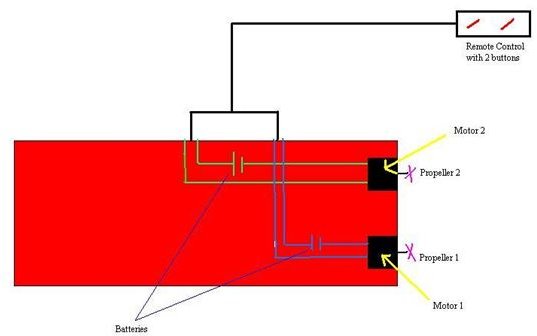
I suggest you take a look at the handmade diagram below and correlate it to this procedure:
-
The wooden platform just needs to be around the size of an A5 sheet (could be say around 10cm by 15 cm which isn’t the standard A5 size). Fix the two electric motors on the end with their rotating shafts pointing outward from the platform. You can use quick-fix, nails or anything you like to make sure they do not move from their positions.
-
Fix the batteries somewhere toward the front (exact position could be different from the picture) in such a manner that the platform has nearly equal distribution of weight so that it does not tilt in either direction when placed in water. You might have to experiment a bit with this and use your intuition/common sense.
Advertisement -
The wiring for the two motors needs to be fixed; I have used different colors to show the wiring for both motors. The thick black lead which comes out of the platform toward the remote control actually depicts that all four wires have been wound together using cello tape for the sake of smoothness. The four wires are connected to two on-off switches on the remote control, which could be just a piece of cardboard or whatever you like.
-
Fix the propellers onto the motors. These could either be removed from any old motor boat toys that you have. You can use any fan type object which has a small hole of insertion into the motor shaft. You might have to struggle around a bit with this, but then that’s DIY is all about – learning by doing.
Advertisement -
Lift the boat in the air and check for the operation of both motors, one by one. Then, place the boat in the tub of water. You can turn on both motors and the boat should go straight if you have fixed both propellers at appropriate distances from the center. When you switch off one of the motors, the boat takes either a left turn or a right turn depending on your position.
-
You can make an addition by making the motors turn both ways by using three-way switches and an extra wire for each motor, so that you can also reverse your boat, but I leave it to you to decide and implement the same.
Advertisement
This might seem to be a bit of a difficult task, but I can assure you that once you complete it successfully, not only will you enjoy watching your own boat go around in water, it would be a big boost to your confidence as well, and perhaps that is one of the main goals of learning skills.