Microsoft PowerPoint can let you make a true multimedia presentation and enhance the audience experience.Templates and backgrounds enhance the visual appeal of the slides you make. Adding audio in various forms adds another dimension to them. Transition sounds as well as background can be added.
Introduction
You can add sound to your presentations in several ways. The first of these is the slide transition sound. Here’s an excellent article at Bright Hub that covers this very well. What I shall describe here are the sounds you want to use during the presentation. It could be music clips, MIDI tracks, or other audio files.
Lots of Free Resources
My query turned up a million odd pages that host such sound clips. We had investigated free templates and themes in a different article and that turned up more than 33 million pages. What that means is that the visual dolling up of the presentations is far more popular than sound effects apparently. What you can expect to find are MP3, WAV and WMA files and couple of other formats too. Besides straight downloads there are sites that offer music boards too. These music boards offer sharing of music with others. While you can upload your compositions, you can also get clips from other through these boards. Typically free samples are offered to get your taste buds excited so that you opt for the premium products available at most such sites. The premium products may be priced per piece or there may be a membership scheme. You start as a free member and get access to a smaller number of free samples. The premium members get larger quotas to unlimited downloads depending on the grades offered..
Some Useful Resources
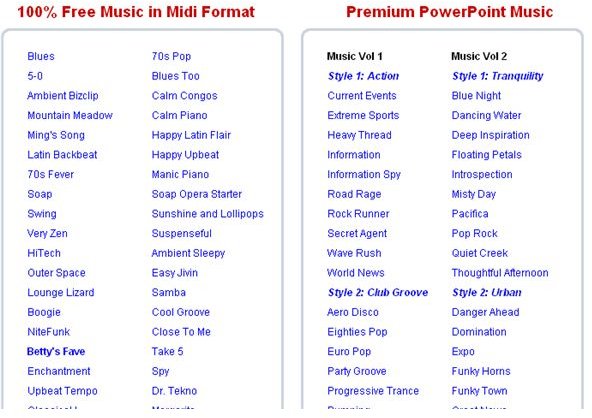
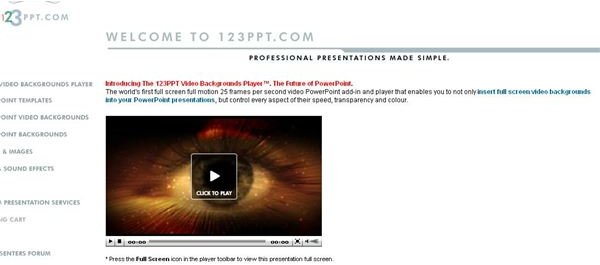
You should be very clear about if the material is for personal use, distribution, commercial use, etc. Copyright of any content is always a sticky issue and you need to be very careful under what conditions you are obtaining the content. Having said that, here are some sample sites that provide a choice of contents and were in the top search results: Presentation Helper , Brainy Betty . These sites turned up tops on our reviews of free templates too. The Brainy Betty site had a large sampling of different genres of music in MIDI format. The premium content offered had categories under groupings like Action, Club Groove, Corporate, Tranquility, Urban and world beat. Sound Board has a sound clip sharing board that we mentioned earlier. Additionally, 123PPT has video clips and a embedded video player that can play a video as a background. That seems to be a new trend and resources have started becoming available.
Images
Few Things to Watch Out For
While listening to the tracks are the best way to judge the quality for yourself, you should be aware of the implications of parameters like the sampling rate, sample size and overall bit rate. There are some standard sampling rates that are used such as 22 kHz, 44.1 kHz, etc. Usually the higher sampling rate will yield better audio quality. Sampling rate beyond 44.1 kHz usually does not exist. It does not improve the quality audibly either beyond the 44.1 sampling rate. Sample size in bits usually is 8 or 16. Once again 16 bit samples gives you better quality. As sample rate increases and you choose bigger sample sizes, overall bit rate increases. There is a trade off involved. Higher bit rate gives you better quality but it also causes a larger music file and consequently a larger presentation. So if you are thinking of distributing it electronically you should watch out for the overall size. Usually smaller sized files are easier to send and publish on the web. WAV files have similar considerations. The MP3 files are generally smaller as the format compresses the original audio to produce smaller files.
For your own protection have your defenses up totally. Have the firewall up and the ant-virus active. That will protect you from malicious content being downloaded to your machine. Once you have your guards up, there are plenty of resources in a truly wide-ranging selection available for you. The best thing to do is to get started with the free stuff and once you get experienced at using the sound files, graduate to better audio files that may not be free, but will usually be of superior quality.