Lesson Plan for Database Applications such as MS Access
Background
Of all the computer applications, Microsoft Access poses the biggest challenges to new students. Before involving students in the at-first overwhelming learning tasks, an introductory lesson about databases in general would ease the class into database immersion. This lesson plan is a general outline for introducing students to databases.
Learning Objectives
After completing this lesson, students should be able to:
♦ Know the basic purpose and structure of databases
♦ Identify at least two everyday examples of database
♦ Be able to describe the concept of relational databases
♦ Understand the instructional approach in learning Microsoft Access
Lecture Notes:
Areas of Discussion for the Class Session:
♦ What is a database?
◊ Define a database as a collection of related records. Talk about the evolution and history of databases. (See link in reference section at the end of the article.)
♦ What are some examples?
◊ Talk about the everyday examples of databases everyone knows about: the telephone book, the IRS and State tax databases, and some commercial products like Money and Tax Cut.
♦ What are the Most Common Types of Databases?
◊ Discuss flat-file, hierarchical, relational databases and object-oriented databases. A Microsoft Excel spreadsheet table can be used as a flat-file data base. Microsoft’s Encarta Encyclopedia is hierarchical, and Microsoft Access is relational.
♦ How do databases differ from spreadsheets?
◊ Discuss how a database and a spreadsheet both share the table architecture, but both have different uses and applications.
♦ What can databases do?
◊ Emphasize the data storage and management role of the database. Return to everyday examples of the phone book. Mention how database fields can be merged with other files for marketing and advertising.
♦ Why should you learn database programming?
◊ Emphasize the advantages of learning database from the point of increasing skills and qualifications. People who know database operation tend to be more competitive in the job market.
♦ In this course, what, specifically will we learn?
◊ Describe Microsoft Access as a data management system with distinct “objects”: fields, tables, queries, forms, reports and macros. Learning will be through a “stair-step” approach to mastering database learning.
Downloadable Lesson Plan
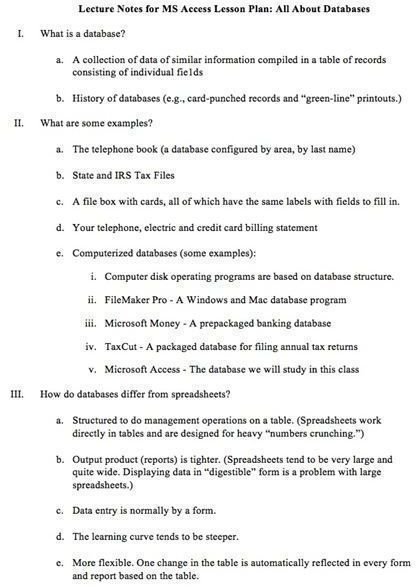
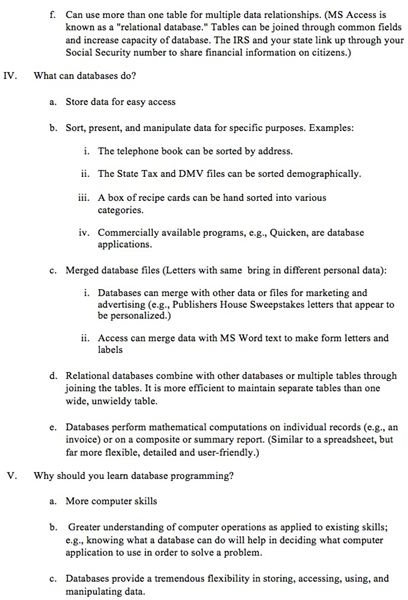
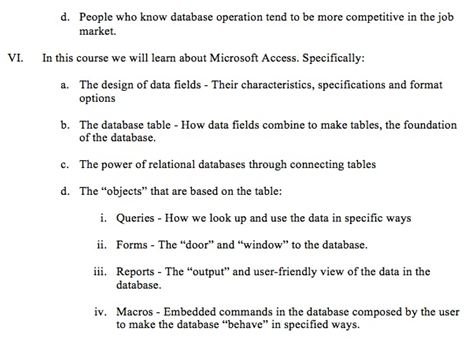
A downloadable expanded version of the lesson plan described above is available at Lecture Notes for MS Access Lesson Plan: All About Databases.
Click on the images below for a preview of the expanded lesson plan:
Suggested Classroom and Homework Assignments
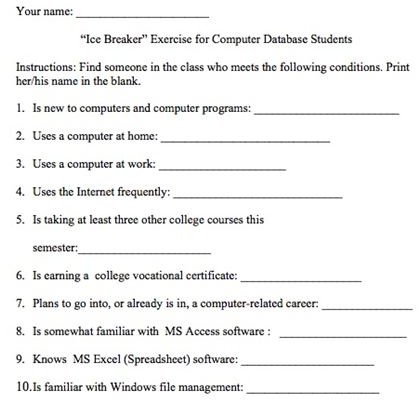
Following the lecture and discussion, distribute the “Ice Breaker” exercise and allow students to circulate. Collect the sheets for future reference. Click on the image below for an example:
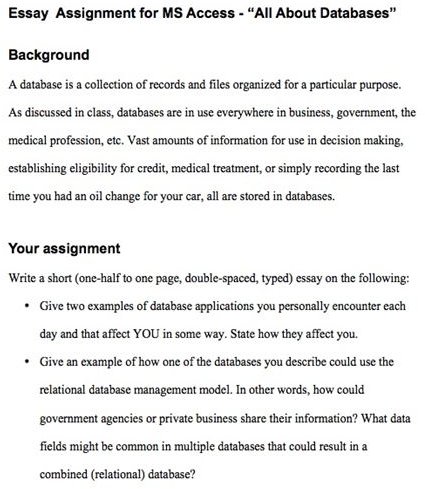
Assign the following homework essay assignment:
Related Bright Hub Articles
MS Access Databases: Tables are the Foundation
When is it time to move to MS Access?
Resources
About.Com: Databases, “What is a Database?”
About.Com: Databases, “A Database Glossary”
What are relational databases?
This post is part of the series: Lesson Plans for MS Access 2007
This is a series of MS Access database lesson plans for adult students. The plans were prepared by Curt Smothers, who is a former community college database applications instructor.
