For mobility and handy situation where most Linux enthusiasts are in need of a flexible recovery kit in their pocket, live Linux OS on USB seems to be a good tool to carry. Just follow these simple steps and be set to go.
In a system administration way of working around networking services hosted by GNU Linux or Linux for short, one must be equipped with a crash recovery kit. The tool kit will enable administrators to analyze and derive a solution for a Linux system crash (which rarely happens). But the rule of thumb will be always applied in a system. There will be a fail-safe recovery procedure that can be implemented once a system breaks down- no matter how perfect the design and implementation of it is.
Fortunately different variance or flavors of Linux offer different approaches to system recovery. One can be a file system check recovery; another is using a rescue disk provided by a respective Linux distribution. But having a USB bootable image of the Linux operating system is the best solution there is for a system recovery. The reason is that Live OS on USB loads the regular settings, drivers, and defaults for immediate usage by users. So hardware involved in the machine can be accessed or used to make sure the hardware is working fine, and users will be able to isolate the problem away from the hardware and concentrate more on the software part behind the Linux operating system. With USB used as a media to install a recovery kit for Linux OS, administrators can bring it anywhere and be ready anytime.
Requirements to Make the Recovery Kit
For a user to come up with a Linux recovery kit in a USB media, users must have the following requirements. Number one material would be the loading media: a minimum size of one (1) gigabyte of free space USB thumb drive.
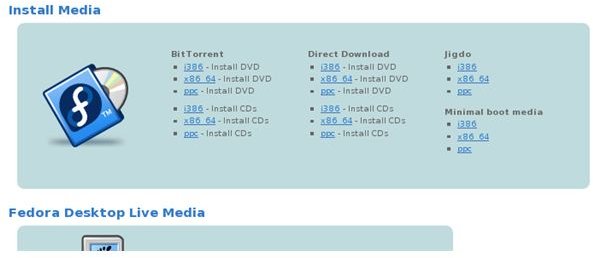
Download an ISO image of Fedora Core Live OS which is more or less 600 MB in size and store it in a folder on a Windows XP operating system. The image can be found at https://fedoraproject.org/get-fedora . Once you get hold of that image, it is time to download the live USB creator from https://fedoraproject.org/liveusb-creator .
Steps for Making a USB Bootable Linux OS
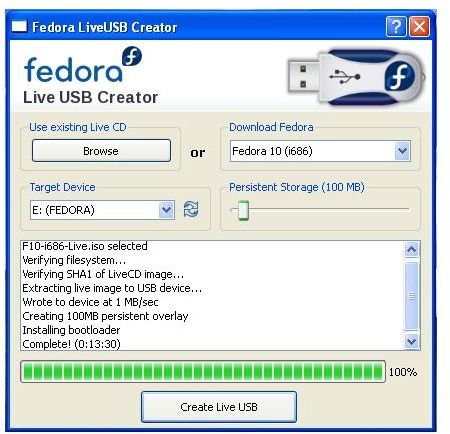
After getting the materials needed, proceed to the following step by step procedures. The liveusb-creator program can be installed in Windows XP and its later versions. Just make sure that the executable program is also located in the folder where the live USB ISO image is residing. Insert the FAT32 formatted USB drive. The moment that the utility has been executed, several parameters should be supplied.
The first thing to do with the program is define the ISO image by clicking the Browse button and locate the image. Set your target device to whatever the drive letter of the USB storage is as defined by Windows. And the last thing to be set is the persistent storage, where it is the size of the drive space a user wants to have for storing static data or configuration files when using the USB Live image of Linux. Then click the Create Live USB button to start transferring the bootable image to the USB drive. Just wait for it to be at 100 % and the USB drive should be ready to boot.
Booting up using USB is a great method to practice. Light versions of Linux are very small and easy to fit in. With just a gigabyte to spare, a user will have a very portable system recovery kit inside his pocket.