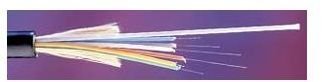
Fiber Optic cabling is the last type of network cabling we’ll discuss - it also happens to be the most complex, expensive, and high-performing of the three. Lets take a look at the technology of Fiber Optic cabling and how it is utilized in modern networking.
What Exactly Is Fiber Optic Cable?
Most of us have heard the term Fiber Optics before, but probably don’t have much of an understanding of what it is. It sounds fancy and cool, kind of like LED lights did when they first exploded onto the market. There are even these really neat looking lamps that use Fiber Optics to create neat little pinpricks of light on the ends of white plastic strands, like this .
The technology really isn’t as complicated or “technical” as the name implies, but when applied to network cabling, it produces some of the fastest data transmission speeds available. Fiber Optic network cabling uses extremely thin strands of glass inside of refractive shielding to transmit data via light, instead of electricity. The benefit of this is that it is completely immune to all types of interference, can travel extremely long distances, and produces higher speeds, due to light traveling faster than electrical signals.
One might think that strands of glass would simply break when bent or even lightly jostled. The strands are so thin (thinner than a human hair), however, that this really isn’t a problem. Each fiber optic cable is rated for a maximum bend angle, but this is due less to the concern of breakage, and more because of how bends in the glass cause reduced “signal strength”, which effectively decreases the distance the beam can travel.
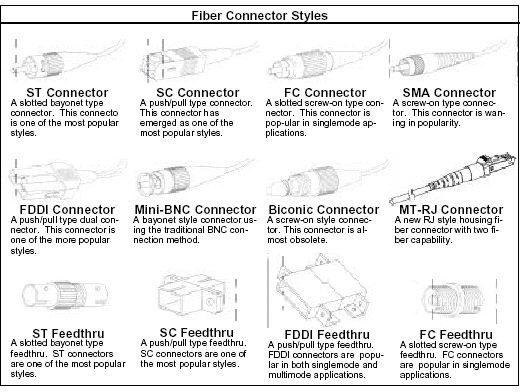
Not all Fiber Optic cables are created equally, however. There are width variances, as well as some that include multiple strands per cable, and additionally there are several different connectors used. Speed, maximum length, single- or multi- mode, and bend radius are just some of the terms used to define fiber cable standards.
In our introductory article of this series we briefly mentioned that there is a network cable that is rumored to be able to kill a person. Though there are no officially recorded deaths due to handling fiber optic cable, in theory it is possible. Fiber optic cable is incredibly thin, and is nearly invisible. This is a problem when creating the cables, because attaching the end-connectors is done by hand. Technicians are required to handle the glass core, and tiny pieces will frequently break off. These pieces will often embed into the skin, which results in minor irritation in most cases. Theoretically, though, the fibers are thin enough to travel through the blood stream and into the heart, which could potentially result in death. With this in mind, there are warnings attached to fiber cables, and technicians must take special precautions when handling fiber cable for any purpose.
Use of Fiber Optic Cabling
Since fiber optic cables have the fastest speeds and longest transmission distance, they are predominantly used in situations where high bandwidth and long distance is needed. They are often the backbones of major systems, like telecom, and Internet service. A 2.2Tbps fiber line traverses the Atlantic ocean. How else do you think we can communicate with Europe?
Fiber optic lines can also be used in small scale applications as well. Businesses will often use fiber lines to connect multiple floors of a building, or other systems that they need very high speeds for. Fiber optic cabling is very expensive, however, so is not widely used for day to day situations. Its usage is on the rise, however, and its very low up-keep costs are leading it to being adopted as a favored method of wiring the networks of large companies.
Image Credits: https://www.arcelect.com/fibercable.htm