Having multiple GPUs in a PC is a good example of something that looks excellent on paper, but often fails to meet expectations. Now Lucid, a brand-new company, has promised to deliver a ground-breaking solution, cracking a problem that both ATI and Nvidia have long failed to solve.
Lucid: Who’s That?
Good question. You’ve probably never heard of Lucid before, even if you’re fairly into mainstream hardware news, and for good reason. They only recently began to exist. In fact, Lucid has no track record to speak of, because they are a start-up focusing on a particular goal. But while Lucid is a start-up, they do have one major backer that should tell you that the technology they’ve founded their company on is more than just a bunch of hot air: Intel, along with other investors, has funded the creation of Lucid.
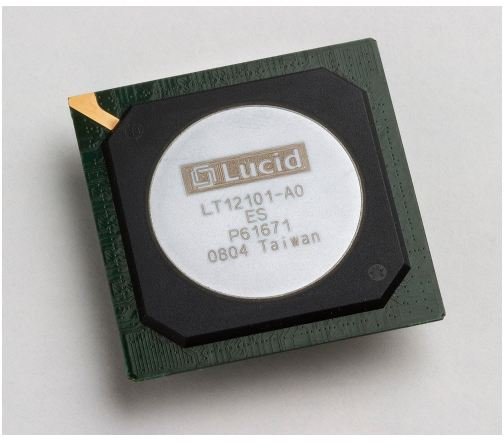
And with good reason: Lucid plans to release a chip, called Hydra, that effeicently balances graphics processing between multiple GPUs. This technology, if it pans out, would be revolutionary. Not only would it increase the potential for graphics cards, but it would also be another step towards the possible replacement of traditional CPUs with GPU-like hardware. To understand why Hydra could be so important, we first need to understand the problem.
The Problem With Multiple GPUs
The state of multi-GPU graphics solutions is better today than it has ever been in the past. But there is still one, fundamental barrier that prevents these products from obtaining their full potential, and that is the way by which multiple GPUs are linked together. Unlike a Phenom or Core i7, multi-GPU cards are not bonded together by a low-level, hardware link which each processor was designed for. GPUs don’t share a common pool of memory - what is known as cache for processors. Instead, the communication between the two GPUs is largely the responsibility of the drivers. In addition, the methods used for scaling performance between two GPUs tend to be fairly simple, with GPUs alternating the responsibility for rendering frames rather than rendering a single frame together.
As a result, performance for multiple-GPU setups often does not scale linearly. Instead, adding a second GPU might increase your performance by as much as 80%, while adding a third might increase performance by 30% . There are even situations where, due to lack of driver support, having multiple GPUs doesn’t result in any increase in performance at all. Multi-GPU computing has become better because drivers have become better and have responded more quickly to new software, but as long as GPUs rely mostly on drivers and other software to tell them how to work, the basic problem will remain. And it is a large problem. For one thing, the way Mutli-GPUs currently work limits the efficiency of memory. While a Radeon 4870X2 technically has 2GB of video RAM, each GPU only has access to 1GB of video ram - and the GPUs don’t know how to share, thus reducing potential performance. The current inefficiency of multi-GPU setups in terms of the performance scaling means that multi-GPU setups are not as cost or power efficient as they could be.
Lucid’s Solution
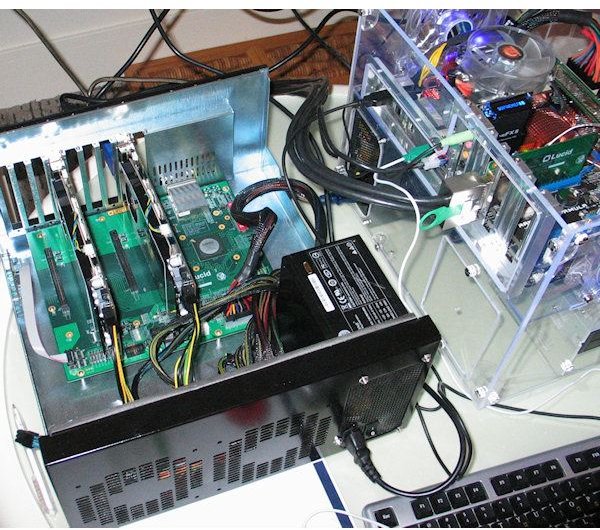
To solve these problems, Lucid has introduced its own piece of hardware, called the Hydra 100. This is not a consumer product yet, and as such no one has tested its potential outside of tech demos at hardware shows. But Lucid did show off examples of what it is
attempting by hooking up two separate monitors, and showing what each GPU involved was rendering. Rather than simply alternating the responsibilities of frame rendering from frame to frame, or splitting up a frame into two halves and having each GPU render its respective portion, Lucid’s technology appears to actively divide portions of a completed frame and then send those portions to individuals GPUs for rendering. So, rather than simply ripping a frame straight in half, Lucid’s technology actually takes textures and world geometry, splits them into chunks of data, and then sends them to different GPUs. The GPUs then render the information given to them, and reassemble the portions in order to create the finished frame. This design is obviously aimed primarily at setups using two to four GPUs, but Lucid says that there is no reason the hardware could not handle hundreds of GPUs.
Being a visual technology, pictures work very well to explain this process. CNET’s blog post on Lucid’s new technology offers some screenshots of the Hydra at work. Those screenshots provide a clear picture of what is occurring.
The Future Is Now
If Lucid can deliver the technology as it promises, then it will have cracked one of the most difficult problems in consumer hardware today, one that both ATI and Nvidia have failed to solve for over half a decade. It is easy to at first brush Lucid off as another smoke-and-mirrors company. Certainly, there have been a fair share of hardware companies which have ultimately failed to deliver - companies like Ageia, which attempted to build a special processor for handling physics in games, comes to mind. Their software solutions for physics were a hit, but the hardware processors never took off.
But for better or worse, we should know the outcome soon. Lucid has stated that they expect the first products to arrive in 2009. It is unclear what those products will be, exactly, because Lucid’s technology could be implemented in a number of ways. It may be integrated into a motherboard or video card, or it may end up needing a PCIe slot. In any case, we shouldn’t have to wait long to see if Lucid can back up its claims. And unlike Ageia and other up-starts, which ultimately needed software support in order for users to gain the most out of their hardware, Lucid’s technology promises to be implemented entirely in hardware. Once the first versions of the Hydra 100 start showing up at tech websites, the technology’s success or failure should become obvious.