Details of the new merchant Foundry to be created from AMD’s manufacturing assets and a lot of money from the UAE.
The Foundry Company (which I shorten to TFC) is a temporary title, but it does have the simple, descriptive quality that took Snakes on a Plane past the working title stage and onto cinema marquees. Not to mention that its parent companies are creatively named Advanced Micro Devices and the Advanced Technology Investment Company. AMD is essentially taking its fabrication assets, making a new company out of them, and selling about 66% of it to ATIC (it was about 56% until a December 8th press release came out announcing an amendment).
It’s much more complicated than that, but we have already discussed the roles, and reasons for taking them, of AMD, ATIC, the government of Abu Dhabi (the owners of ATIC), and Mubadala (another Abu Dhabi owned firm involved in the deal). Here we focus on their new baby.
The Foundry Company
AMD is going to transfer all of its manufacturing assets to TFC. This includes its existing world class fabrication plant (Fab 36) in Dresden, Germany, the ground work on a neighboring plant (Fab 38), along with employees and intellectual property, altogether valued at about $1.8 billion for purposes of the deal. ATIC will kick in $2.1 billion when the deal closes, plus from $3.6 billion to $6 billion over five years to bring Fab 38 online ($2 billion), and a new plant, Fab 4X (presumably named by a more punning person than whoever came up with “The Foundry Company”), which will cost about $4 billion. AMD will also be transferring $1.2 billion in debt to TFC.
At closing, AMD and ATIC will own 34.2% and 65.8%, respectively, in economic terms, but have equal voting rights. As ATIC pours money into expansions and new factories, AMD has the option of matching their investment. If AMD would rather not, ATIC’s economic ownership goes up. At 75% and 90%, ATIC gets rights to, under certain circumstances (some at 75%, more at 90%), break a deadlock that results from the evenly split voting shares. ATIC can also trigger a “transition period” after which they can leave the agreement. AMD’s October 7th SEC filing is thin on details here, AMD and ATIC having provided them to the SEC along with the request that they be treated as confidential.
Perhaps of more interest than any other aspect of the deal to those with ties to the US manufacturing industry, Fab 4X will be located in the New York capitol region, directly employing almost 1500 manufacturing workers. There is a lot to this side of the deal, like expecting New York to give TFC the same $1.2 billion in subsidies and incentives they were planning on giving AMD. More on this next.
So AMD will Pay TFC to Manufacture It’s Chips?
That’s the gist of it. The major points of the Wafer Supply Agreement (the sheets of semiconductors, which are then cut into dies, out of which individual chips are made, are called wafers) are disclosed in the 8k filing (page 8). AMD will buy its CPUs from TFC with the price determined as a percentage of what AMD spends on making them overall (their Cost of Goods Sold). As soon as TFC gets its 32nm fabrication capacity up, AMD will buy, “where competitive,” some of its GPUs from them, the percentage increasing over the course of five years.
If AMD and ATIC can’t reach an agreement on something, AMD can go elsewhere to get its chips, and ATIC can start a “transition period.” As we said previously, many details of the agreement are confidential. In that scenario, TFC “will agree to use commercially reasonable efforts to assist” AMD in moving production to another foundry, and will keep making CPUs and GPUs at the prices already agreed to, for two years.
What If AMD Chips Don’t Sell Well?
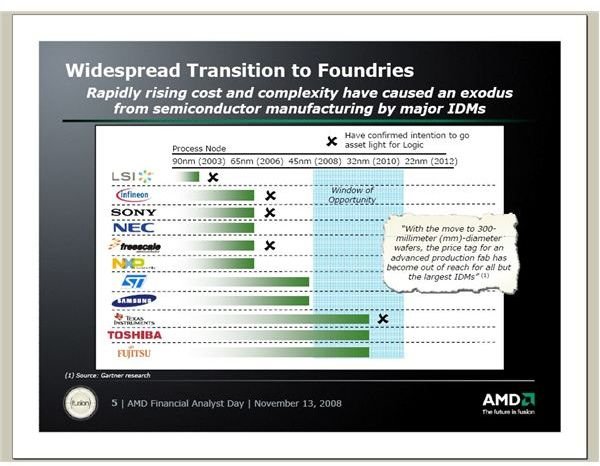
TFC will not only be making semiconductors for AMD, they will be operating as a merchant foundry. That means they will be manufacturing other companies’ chip designs on a contract basis. This is a growing trend in the semiconductor industry (because of difficulties in backward integration, explained here ) as the chart (from AMD ) to the right shows.
Clients of foundries come from a far wider breadth of industries than the computing and consumer electronics fields which immediately come to mind. Medical, transportation, measurement and control equipment, telecommunication, and other businesses are heavily dependent on semiconductors. So is the military, with which AMD does business.
Deal Needs Approval from Many Groups
Any transaction of this size needs to be accepted by a wide variety of regulators and investors (discussed here) , none of which are like to disagree too strongly. Even Intel is unlikely to interfere , though some argue they could via AMD’s x86 licencense. But plans for The Foundry Company will undergo even more scrutiny from CFIUS because of the foreign involvement and AMD’s military contracts . AMD has already obtained approval for the $1.2 billion from the State of New York mentioned above.
This post is part of the series: AMD Creates a Subsidiary for It’s Manufacturing Operations: Will this Create Better CPUs and Create American Jobs?
Can money from Abu Dhabi help AMD stay competitive with Intel past 2009 and provide opportunities in the beleaguered US manufacturing sector?
- AMD Might Claw Back some Desktop Market Share in 2009
- Intel vs AMD: 2010 Could Be a Slow Year for AMD Processors
- What Is Driving the AMD Foundry Spin-Off?
- Challenges to AMD’s Vertical Integration Make Foundry Spin-Off Attractive
- AMD Fabrication Spin-Off: The Big Players
- Money for AMD Comes from Mubadala and ATIC
- What We Know about The Foundry Company: the Working Title for the AMD Fab Spin-Off