AMD Deals with the Disadvantages of Backward Vertical Integration
How Stable Is Demand for Your Product?
If you make toothpaste, people will always need a reasonably predictable amount of it, so opening a gypsum quarry to ensure you always have gypsum with needed qualities in needed amounts makes sense, as does developing appropriate marketing and distribution capabilities. And yes gypsum is an ingredient in toothpaste.
If you make drywall and do the same thing, a down-turn in the new housing market, which is very sensitive to the general economy, means you aren’t just stuck laying off people and selling off equipment at the factory, you have a big expensive gypsum quarry full of even more expensive processing equipment, warehouses full of gypsum and drywall with trucks parked outside, and offices full of sales people that are down to cold calling. Do you sell all this stuff when the gypsum market is down? Keep it but lay everyone off and try to keep up on the leases? Or keep everyone working and hope you don’t go bankrupt sitting on a mountain of gypsum three months before people need drywall again.
AMD is in kind of a tough spot here. Semiconductor manufacturing is reasonably stable (fewer people run out for a new laptop in a bad economy, but computing is so pervasive that you can almost always find customers) but owning their own fabs means that if demand for their products isn’t keeping up, they have very expensive labor and equipment sitting idle. If their products do really well, they might run out of the capacity to make enough of them.
Adding semiconductor manufacturing capacity costs hundreds of millions if not over a billion dollars, and takes at least a year (see the section on needing a lot of money, below). As AMD gains or looses market share based on its head to head competition with Intel, they can run into these problems.
Access to Capital, or Having Lots of Money
You need deep pockets, relative to your competition, and to the industries you want to integrate into. You don’t see a small pizzeria go out and buy a cheese factory and dairy farms. If the big pizzeria chain decides to do just that, a smaller chain should hesitate to follow suit. They would now be the underdog in two markets, and the new one is using up a lot of their resources due to the relatively large investments, management, administration, etc., required.
That is all the more reason for AMD to spin off the fabs. AMD may be huge, but a semiconductor plant is one of the most expensive investments that can be made; you’re looking at over one billion, usually several billion, and you have to wait a couple years for everything to get rolling. Reduced demand (discussed above) can lead to excess capacity, which is terribly expensive in semiconductor manufacturing.
Now factor in that AMD is head to head with the much larger Intel not only when designing products, but manufacturing them. Intel can afford to bring capacity online and not have it fully utilized to a far greater extent than AMD.
Problematic In a Fast Moving Industry
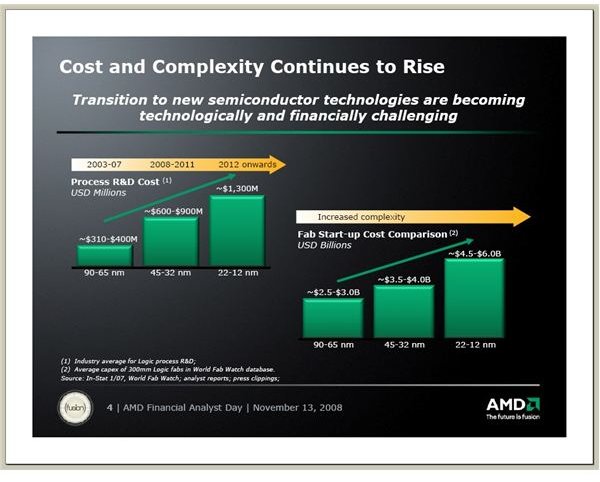
Another big obstacle to successful vertical integration is how fast things change in the target industry. The toothpaste or drywall maker mentioned above, once they buy their gypsum quarry, won’t have to upgrade their equipment that often. Obviously, this isn’t the case for CPUs or semiconductor products in general. The chart at the right, from AMD, shows how many billions of dollars they spend every time they shrink their process technology.
So we can see why AMD wants to be less involved with manufacturing and focus on designing and selling chips. With the economic theory for the decision covered, we get into exactly how AMD plans to go about it in the next article.
This post is part of the series: AMD Creates a Subsidiary for It’s Manufacturing Operations: Will this Create Better CPUs and Create American Jobs?
Can money from Abu Dhabi help AMD stay competitive with Intel past 2009 and provide opportunities in the beleaguered US manufacturing sector?
- AMD Might Claw Back some Desktop Market Share in 2009
- Intel vs AMD: 2010 Could Be a Slow Year for AMD Processors
- What Is Driving the AMD Foundry Spin-Off?
- Challenges to AMD’s Vertical Integration Make Foundry Spin-Off Attractive
- AMD Fabrication Spin-Off: The Big Players
- Money for AMD Comes from Mubadala and ATIC
- What We Know about The Foundry Company: the Working Title for the AMD Fab Spin-Off
