With no Bulldozer or Fusion CPUs Until 2011, will there be any AMD processors that can compete against Intel’s Sandy Bridge in 2010?
The previous article explained how AMD’s Phenom II may make some inroads as Intel fans hesitate to choose which of Intel’s new sockets to buy over the course of 2009. But with Intel already crossing the Sandy Bridge (the codename for the architecture to succeed Core) in the second half of 2010, things don’t seem as positive for AMD come the end of the decade.
The Storm after the Calm
By the end of 2009, Intel will have its new Core architecture well established in the enthusiast market, will be finding it’s way into the hands of performance (the level between enthusiast and mainstream, below that is termed value) users.
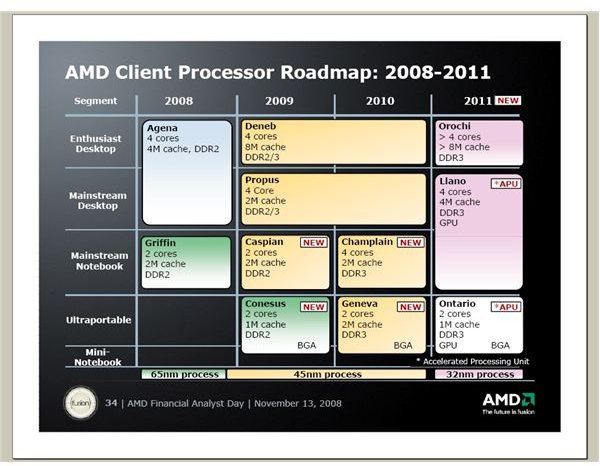
AMD road maps (the one on the right is from a presentation at their Financial Analyst Day, November 13th ) don’t show anything for the desktop except no more Phenom tweaking until 2011, when the Bulldozer core (last supposed to appear in ’09 on a now defunct CPU codenamed Shrike) is slated for launch. This, at 32nm in Orochi, Llano, and Ontario CPUs for enthusiast, mainstream and netbook markets, respectively.
Where Did the Fusion Powered Bulldozer Go?
The time machine feature went off unexpectedly: apparently now it won’t be seen until 2011. The 45nm CPUs line that was to use the Bulldozer core, set to appear in 2009 last we heard of it, and codenamed Shrike, has shrunk to invisibility and can no longer be found.
Not much is known about Bulldozer, and it’s impossible to tell whether it will be ready to go on time; let alone whether it will live up to its name and crush anything in front of it; or live up to its name and be really slow, use a lot of power, and need a lot of special care and maintenance. One thing is for sure; we’ll be waiting for a while to find out. Some good news: while we will still be waiting until 2011 for the part to launch, AMD had offered further details of the Bulldozer CPU architecture .
Fusion, AMDs brand for integrated graphics on the CPU, was also pushed out to 2011, when it should appear on Llano and Ontario.
Any More Bad News?
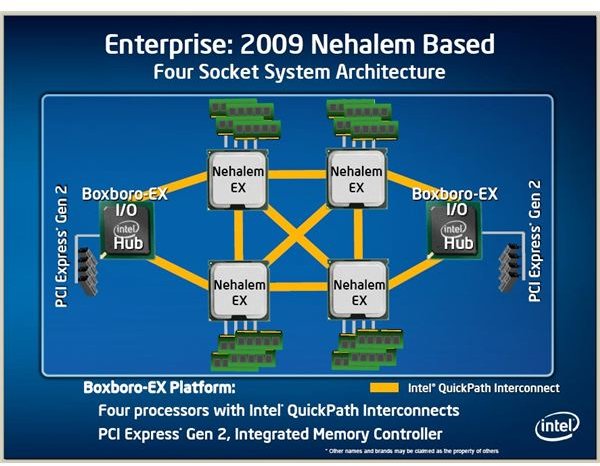
Things aren’t much prettier on the server front, since Intel’s new Core architecture was in large part designed to address its weakness in this direction, with features like Quick Path Interconnect. Yes, QPI is faster than the Front Side Bus used with Core 2 and there is a benefit to the desktop user , but there are far larger benefits on servers using several CPUs. Each CPU has a dedicated QPI for each other CPU, so they can speak directly to one another, as shown in the diagram to the left.
The FSB was a real bottleneck in these cases, allowing AMD powered servers to compete despite having weaker CPUs. Core architecture replaces the current Core 2 Xeon family in early 2009, and should be at least beginning to gain traction by ’10. This is likely to at least equalize the ground Intel had always lost to AMD’s HyperTransport technology.
The Red Team is planning a new platform for 2010, codenamed Maranello, using CPUs codenamed Magny-Cours and Sao Paulo. It seems to largely be a move to DDR3 and more cores per chip. That may not cut it against the Blue Team’s Core, or by then Sandy Bridge CPUs, particularly if you have to buy a new platform anyways.
And That is If They Hit Their Targets?
Exactly, and we probably haven’t forgotten about that TLB incident that held up the last Phenom yet. In AMD’s favour though, they have pushed a lot of their dates back with the most recent roadmap, so they may be trying to get the delay related disappointment out now instead of later. Not a bad idea if you figure people are more interested in the Phenom II that’s coming out next month at this point in time.
Giving lots of warnings about product delays is also appreciated by shareholders, who will soon be voting on a huge set of changes at AMDfavor. With things looking a little grim in 2010 and unclear after that, it is a good thing that these changes should net the Red Team a lot of cash as they spin-off their manufacturing assets. We look at the proposed spin off, along with its business and technical implications in the rest of the series.
This post is part of the series: AMD Creates a Subsidiary for It’s Manufacturing Operations: Will this Create Better CPUs and Create American Jobs?
Can money from Abu Dhabi help AMD stay competitive with Intel past 2009 and provide opportunities in the beleaguered US manufacturing sector?
- AMD Might Claw Back some Desktop Market Share in 2009
- Intel vs AMD: 2010 Could Be a Slow Year for AMD Processors
- What Is Driving the AMD Foundry Spin-Off?
- Challenges to AMD’s Vertical Integration Make Foundry Spin-Off Attractive
- AMD Fabrication Spin-Off: The Big Players
- Money for AMD Comes from Mubadala and ATIC
- What We Know about The Foundry Company: the Working Title for the AMD Fab Spin-Off