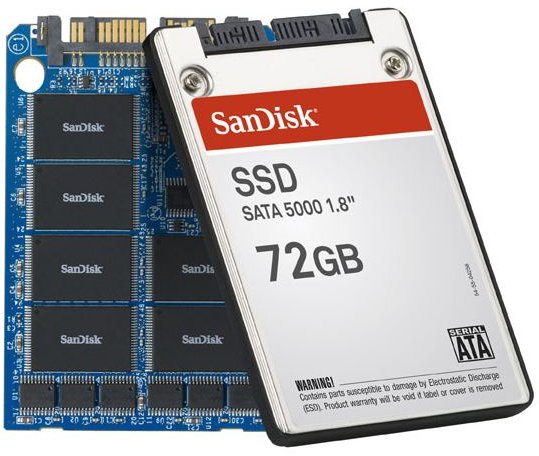
Solid State Drives (SSDs) are a lighter, faster and quieter alternative to traditional hard drives, but they have some important disadvantages. We explain what both Microsoft and the SSD industry are doing to improve performance of the drives in Windows.
What is a solid state drive?
In short, a solid state drive is a permanent storage device which works in a similar way to a digital camera memory card, but is specially designed to work as an alternative to a hard disk.
For a more detailed explanation, please see my article at:
https://www.brighthub.com/computing/hardware/articles/9104.aspx
What are the existing problems?
As I mentioned in my previous article, SSDs are still comparatively expensive and don’t have as much storage space as some hard drives; however both of these problems are gradually reducing over time and they could be a financially viable option in mass-market laptops within a couple of years.
The biggest problem is that Windows simply isn’t set up to work efficiently with SSDs, which are made up of a smaller number of sections, each with more data, than a traditional hard drive. These sections are larger than the amount of memory Windows can handle at any one time, meaning SSDs don’t work as well as they could under perfect conditions.
Will Windows 7 now solve this problem?
Not as such: there’s no easy way to alter Windows to make full use of an SSD without affecting performance of traditional hard drives (which would substantially outweigh the benefits). Most technical experts believe the solution is to have a completely separate technology for Windows to communicate with SSDs, rather than continuing to use SATA, the system designed for traditional hard drives.
However, it doesn’t appear that this will be done for Windows 7. That’s likely because Microsoft believes there won’t be enough people using SSDs by the Windows 7 release date to make it a priority. They are, however, planning some smaller changes.
What difference will Windows 7 make?
Microsoft has announced three technical changes which will improve SSD performance in Windows 7:
- Windows will use a more intelligent system for deleting old data from SSDs. This will make access quicker and cut down on wear and tear.
- SSDs can be partitioned more efficiently. This will cut down on the number of times the computer has to access an SSD.
- Computers will no longer attempt to automatically defragment SSDs. Because of the way an SSD works, defragmenting is both unnecessary and potentially damaging.
Microsoft is also launching a certification scheme for SSDs to make sure as many drives as possible are automatically recognised as a solid state drive by Windows (which can then apply the new settings listed above).
What is the industry doing?
SanDisk, one of the leading manufacturers of SSDs, has announced a new technique for reading to and writing from the drives. It deals with the problem that when a computer writes to an SSD, it must first delete any data in one particular section of a disk, and then rewrite both the existing and new data.
At the moment, computers try to write to the first section of an SSD which has any space available, which can be inefficient. SanDisk’s new technique will force the computer to look for the section which has the most suitable gap for the new data, cutting down on unnecessary erasing and rewriting. The company believes this will make SSDs run as much as 100 times quicker. There’s also a useful side-effect: it will spread the data more widely across the disk, which reduces the problems of particular sections being used far more frequently and wearing out quicker.
The company is also asking other SSD manufacturers to work together to produce new methods of measuring the speed and lifespan of each particular model of drive. It believes existing methods, which are largely based on traditional hard drive specifications, don’t give a fair picture of SSD performance.
SanDisk is also working a new system to allow drives to learn a particular computer’s regular patterns of storing data and adapting to meet them more efficiently. In particular, the drives should learn how common Windows applications work and what they need from a storage device.